LIMS Software in Hyderabad: How to Choose the Right System
Quick answer: The right LIMS software in Hyderabad depends on your laboratory’s actual workflow. For a pathology or diagnostic lab, look for patient registration, sample tracking, barcode support, result entry, reporting, approval, billing and integration with the equipment you actually use.
This guide is mainly for pathology labs, diagnostic centres, hospital laboratories and clinics in Hyderabad. If you run a pharma QC, research or industrial laboratory, your requirements may be different, so use the workflow—not the software label—as your starting point.
If you are looking for LIMS software in Hyderabad, don’t start by comparing the number of features on each vendor’s website. Start by identifying the laboratory workflow you need to control.
A pathology or diagnostic lab needs patient registration, test orders, sample tracking, result entry, reporting, approval and billing. A pharmaceutical or industrial laboratory may need a very different system built around specifications, stability, instruments, quality control and regulatory workflows.
That distinction saves a lot of wasted time.
What does LIMS software actually need to handle?
Short answer: For a clinical or pathology laboratory, a LIMS should connect the journey from patient registration and test order through sample collection, testing, result approval, reporting and payment.
For a clinical or pathology laboratory, the software should follow the patient’s sample from the first order through the final report.
That means the workflow needs to connect:
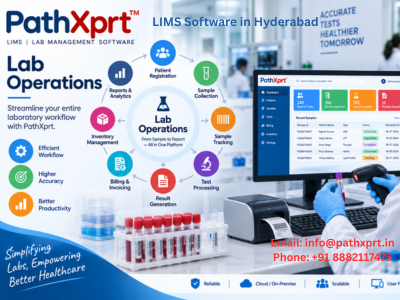
Patient → Order → Sample → Testing → Result → Approval → Report → Payment
If a system handles only report printing, it isn’t solving the whole laboratory management problem.
Current Hyderabad-focused products show how broad the category has become. Some focus on pathology operations such as registration, sample tracking, billing and digital reports. Others are aimed at pharma or industrial laboratories with very different requirements.
So the first question for a buyer isn’t “Which LIMS has the most features?”
It is:
“Is this software built around the work my laboratory actually does?”
What Is LIMS Software?
Are you looking for pathology LIS software or a broader LIMS?
Short answer: Choose software around the type of laboratory you operate. Pathology and diagnostic labs are patient-and-sample focused, while pharma and industrial labs may need batch, stability, quality and regulated-document workflows.
This is the part many comparison pages gloss over.
A diagnostic laboratory typically revolves around patients, investigations, specimens and reports. A pharma QC laboratory may revolve around batches, specifications, stability studies, instruments and controlled documentation.
Both may be called LIMS.
They are not necessarily interchangeable.
For example, CaliberLIMS describes its product specifically as a pharma LIMS and highlights GMP, GLP, 21 CFR Part 11, laboratory resources, instrument calibration and ERP integration. LimsPulse similarly emphasizes stability, calibration, microbiology and regulated laboratory operations.
If you operate a pathology lab in Hyderabad, don’t choose software simply because its website says “LIMS.”
Ask the vendor to demonstrate your clinical workflow.
That one request removes a lot of noise.
What should a Hyderabad pathology lab expect from its LIMS?
Short answer: A pathology lab should be able to demonstrate the complete patient-to-report workflow, including registration, sample collection, accessioning, testing, result entry, approval, reporting and payment.
A good demo should begin at reception.
Create a patient. Select the required tests. Generate the order. Collect and identify the sample. Move it through the testing workflow. Enter the result. Send it for approval. Generate the report and record the payment.
That is your real test.
PathXprt is positioned as a cloud-based laboratory information management system for diagnostic labs, hospital labs, clinics and individual laboratories. Its published workflow covers order management, sample collection, accessioning, pathology, reporting, approval, dispatch and finance.
That workflow is much closer to what a diagnostic laboratory buyer should evaluate than a generic list of software modules.
Sample tracking should be tested, not just advertised
Short answer: Ask the vendor to follow one real sample from collection to reporting, including barcode scanning, rejection, transfer and later history lookup. That tells you more than a feature list.
Sample tracking sounds simple until a laboratory has multiple tests, collection points or outsourced investigations.
PathXprt’s accessioning features include barcode printing and tagging, sample tracking, sample segmentation, outsourcing workflows, sample acceptance/rejection, archiving and direct barcode scanning.
The important part is not the word “barcode.”
Ask the vendor to show you the complete sample journey.
What happens after registration?
How is the sample identified?
Can the technician find it immediately?
What happens if a sample is rejected?
Can its history be traced later?
Those answers tell you whether the software actually fits your laboratory.
[INTERNAL LINK: Sample Tracking in LIMS]
Reporting needs more attention than a nice-looking PDF
Short answer: Test reporting with your own test names, reference ranges and report format. The important part is how results move from entry to review, approval and final dispatch.
Your report is the final product the patient or referring doctor sees.
So don’t judge reporting software from one attractive sample report.
Test the workflow behind it.
PathXprt lists digital report generation, custom report templates, speech-to-text entry, bulk reporting and an error-checking engine. It also provides a report approval workflow with secure physician logins and verification.
During a Hyderabad LIMS demo, ask the vendor to create one of your actual reports.
Use your test name.
Use your reference ranges.
Use your laboratory’s preferred format.
Then check how the report moves from result entry to approval to dispatch.
That is where the practical difference between systems becomes obvious.
What happens when your lab uses analyzers?
Short answer: Give the vendor the exact analyzer models used in your lab and ask them to demonstrate result transfer, error handling and review before approval. “Analyzer integration” should be tested, not assumed.
If your laboratory uses automated analyzers, integration deserves its own discussion.
PathXprt lists direct laboratory equipment interfacing for automated results.
But “supports analyzer integration” is too broad to make a buying decision.
Give the vendor the exact machine models used in your laboratory.
Ask:
- Is this analyzer supported?
- How are results transferred?
- Is the interface included?
- How are abnormal or failed transfers handled?
- Can results be reviewed before approval?
Billing should be part of the laboratory workflow
Short answer: If your lab handles payments inside the same workflow, test whether the LIMS connects orders, performed tests, rates, discounts, invoices and outstanding dues without duplicate data entry.
A laboratory does not stop at testing.
Someone has to collect payment, apply the correct rate, manage discounts and track outstanding amounts.
PathXprt’s published finance module includes online and offline payments, dues collection, invoices, multiple rate lists, discount structures and MIS reporting.
That matters when the same system needs to connect what was ordered, what was performed and what was billed.
During your demo, don’t ask only whether billing exists.
Give the vendor one real example from your lab.
For example, use a test package, a referral rate or a discount structure that your staff actually uses.
Then see how many steps are required.
[Pathology Lab Billing Software]
Do you need cloud LIMS in Hyderabad?
Short answer: Cloud LIMS can be useful for branches and distributed teams, but the buying decision should also cover permissions, backups, data export, support and what happens during an internet outage.
PathXprt describes itself as a cloud-based platform, with centralized management and support for multiple locations.
Cloud deployment is useful when your laboratory has users who need access from different locations or when branches need centralized management.
But don’t buy software because “cloud” sounds better.
Ask about user permissions, backups, data export, access control and implementation.
Also ask what happens if the internet connection is temporarily unavailable and how the vendor handles support during an operational problem.
These are boring questions.
They are also the questions you are glad you asked later.
What makes PathXprt worth evaluating in Hyderabad?
Short answer: PathXprt is worth evaluating when its published clinical-lab workflow matches your requirements for registration, samples, reporting, billing, analyzer integration and multi-location operations. The final decision should come from a workflow demo.
PathXprt isn’t a Hyderabad-based product according to its published company address; its listed address is in Sector 63, Noida, Uttar Pradesh.
That should be clear rather than hidden.
The reason a Hyderabad laboratory might still evaluate it is the workflow rather than the vendor’s physical city.
PathXprt publishes features covering order management, sample collection, accessioning, pathology, digital reporting, report approval, dispatch, finance, analyzer interfacing and multi-location management.
For a diagnostic lab looking for one platform across those stages, those are the capabilities worth testing.
[PathXprt LIMS Software]
What if your laboratory is a pharma or research lab?
Short answer: Do not evaluate a clinical pathology workflow against pharma or research requirements. Build the demo around the work your laboratory actually performs, such as stability, batch testing, quality control or research sample management.
Then don’t force a pathology-focused workflow onto the problem.
Hyderabad has a substantial laboratory and life-sciences software market, and current search results include systems specifically aimed at pharma and regulated laboratory environments. CaliberLIMS focuses on pharma laboratory automation and compliance workflows, while LimsPulse highlights 21 CFR Part 11, ALCOA+, GAMP 5 and ISO/IEC 17025.
That is a different buying requirement.
If your primary work involves stability studies, controlled laboratory documentation, calibration, batch testing or regulated pharma QC, your demo checklist should be built around those processes.
If you run a diagnostic or pathology laboratory, build it around patient-to-report workflow instead.
Same acronym.
Different job.
How should you compare LIMS vendors in Hyderabad?
Short answer: Give every shortlisted vendor the same patient-to-report scenario and one real-world complication, such as a rejected sample, corrected result, outsourced test or second collection location.
| Area to test | What to ask the vendor to demonstrate |
|---|---|
| Registration | Create a patient and test order using your normal workflow. |
| Sample tracking | Print/scan the sample and show its current status and history. |
| Reporting | Create a real report and take it through review, approval and dispatch. |
| Analyzer integration | Use your actual analyzer model and show result transfer and exception handling. |
| Billing | Test your rate, package, discount and payment scenario. |
| Multi-location | Move a sample/order between locations and show permissions and visibility. |
Don’t compare ten vendors using ten different feature lists.
Give each vendor the same test.
Use one realistic patient journey:
Registration → Test Order → Sample Barcode → Testing → Result Entry → Approval → Report → Billing
Then add one complication.
Maybe a rejected sample.
Maybe a corrected result.
Maybe an outsourced test.
Maybe a second collection location.
Watch what happens.
The best demo isn’t the one with the most animations. It is the one where your staff can understand what they would actually do every day.
Who is PathXprt a good fit for?
Short answer: PathXprt is positioned for diagnostic labs, hospital labs, clinics and individual laboratories that want connected registration, sample, reporting, finance and laboratory workflows.
PathXprt is positioned for diagnostic labs, hospital labs, clinics and individual laboratories. Its published product information describes a cloud-based system combining laboratory management, billing and reporting.
It is worth evaluating if you want a connected laboratory workflow rather than separate tools for registration, samples, reports and finance.
It may not be the right choice if you need a highly specialized pharma QC platform with requirements that go beyond a clinical diagnostic workflow.
That isn’t a weakness.
It is a buying-fit question.
The five questions I would ask before buying LIMS software in Hyderabad
Key takeaway: A good LIMS should make your team’s daily work easier to follow, not simply add another dashboard. Before buying, test the actual workflow, the exceptions and the support process.
Before signing anything, ask the vendor these five questions:
1. Can you demonstrate our complete sample-to-report workflow?
Not screenshots. A live workflow.
2. Can you integrate our actual analyzer models?
Give them the model numbers.
3. Can we customize our report formats?
Use a real report during the demo.
4. What happens to our data if we leave the platform?
Ask about export and migration.
5. What support do we receive after implementation?
Ask who handles training, technical issues and workflow changes.
Those answers are more useful than a generic “best LIMS software” ranking.
Ready to evaluate LIMS software for your Hyderabad laboratory?
Bottom line: For a Hyderabad diagnostic or pathology lab, evaluate LIMS software against your real patient-to-report workflow. The most useful demo is one that uses your tests, report format, billing rules and analyzer requirements.
If your laboratory is looking for a clinical LIMS rather than a pharma QC system, start with your actual workflow.
PathXprt provides a published workflow covering order management, sample collection, accessioning, pathology, reporting, approval, dispatch and finance, along with barcode management, analyzer interfacing, custom reporting and multi-location support.
Don’t buy from the feature page alone.
Request a PathXprt demo and ask the team to run one real patient-to-report workflow using your tests, report format, billing rules and analyzer requirements.
If the software handles those requirements comfortably, you have a much more useful basis for a purchase decision than a generic list of LIMS features.
LIMS Software in Hyderabad: FAQs
What is LIMS software?
LIMS software is a laboratory information management system that connects laboratory records and workflows such as orders, samples, testing, results, reporting and related operations.
Which LIMS is suitable for a pathology lab in Hyderabad?
The suitable system depends on your workflow. A pathology lab should test patient registration, sample tracking, barcode support, result entry, reporting, approval, billing and required integrations.
Is cloud LIMS useful for Hyderabad laboratories?
It can be useful for labs with multiple locations or distributed users, but you should also evaluate access control, backups, data export, support and internet-outage procedures.
Can LIMS integrate with laboratory analyzers?
Many LIMS platforms support analyzer integration, but support varies by device. Always provide the vendor with the exact analyzer models and ask for a live demonstration.
How should I compare LIMS vendors?
Give each vendor the same real laboratory workflow and ask them to demonstrate both the normal journey and an exception such as a rejected sample, corrected result or outsourced test.
Need a practical LIMS evaluation? Ask PathXprt to demonstrate one complete patient-to-report workflow using your laboratory’s actual requirements.