The best LIMS software in Nairobi Kenya is not simply the product with the longest feature list. The right choice is the system that fits the laboratory’s workflow, integrates with the instruments and hospital systems it actually uses, protects traceability, and comes with dependable implementation and support.
That is the real buying problem behind this search. A diagnostic laboratory, hospital laboratory, public-health facility and testing laboratory do not necessarily need the same LIMS.
What is a Nairobi laboratory actually trying to buy?
Usually, the buyer is not looking for another dashboard. They are trying to control the journey from test request to verified result.
That means patient or sample registration, identification, sample movement, testing, result entry or analyzer import, verification, reporting and data access. For larger organizations, it also means integration with the hospital information system, other applications and laboratory instruments.
Kenya’s Ministry of Health has published procurement requirements for a comprehensive National Laboratory Information Management System for the Kenya National Public Health Institute. The published technical requirements address legal, regulatory and information-security considerations, including confidentiality, integrity, access control and audit trails.
That is useful context for any Nairobi buyer: LIMS is an operational information system, not just a piece of reporting software.
[INTERNAL LINK: Laboratory Information Management System for Pathology Labs]
What should a LIMS handle before you consider advanced features?
Start with the sample.
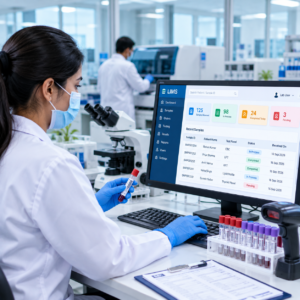
A medical laboratory needs a controlled path from registration to report release. Depending on the facility, that can include patient registration, test ordering, sample collection, barcode identification, accessioning, result processing, verification and report delivery.
A quality-control or testing laboratory has a different emphasis. It may need sample receipt, test assignment, analyst workflows, instruments, quality checks and certificates.
The software should follow the laboratory’s real process rather than forcing staff to create workarounds.
Which LIMS features matter most for Nairobi diagnostic laboratories?
Patient and sample registration
The first screen should make identification clear. If staff have to re-enter the same information in several places, the problem is not solved by adding more features later.
Barcode support is worth testing with the actual collection and accessioning workflow.
Result entry and verification
Results need a controlled route from entry or instrument import through review and final release. Ask how the software handles corrections, abnormal values, comments, units and result approval.
Analyzer and instrument integration
Do not accept “analyzer integration” as a checkbox.
Give the vendor your analyzer list. Ask which models are supported, which communication protocols are available, how worklists move to instruments, how results return to the LIMS, and how test codes and units are mapped.
Kenya Revenue Authority LIMS documentation includes requirements around laboratory sampling, registration and analysis, showing that instrument and workflow integration matters beyond ordinary patient-reporting use cases. citeturn0search43
[INTERNAL LINK: Bidirectional Analyzer Interfacing in LIMS]
Hospital or HMIS integration
A hospital laboratory should not be evaluated in isolation.
Kenya Medical Supplies Authority documentation for LIMS implementation explicitly referred to instrument integration and integration with the Hospital Information System. citeturn0search44
Ask the vendor to demonstrate the complete exchange: order, patient identity, sample, result and final report.
Reporting and communication
Check how reports are generated and delivered to the people who actually use them. That could include clinicians, patients, hospital departments or referral partners.
Do not assume that every product’s “digital reporting” feature works the same way.
Billing, inventory and operational controls
Some diagnostic laboratories need billing, payment tracking, inventory and consumable management alongside the core laboratory workflow. Others already have separate systems.
Decide where LIMS ends and another system begins before signing a contract.
What makes LIMS software suitable for Kenya?
Local relevance is more than using the word “Kenya” on a landing page.
A Nairobi buyer should ask about connectivity, local implementation, technical support, data protection, integrations and the workflows used by the facility.
Kenya’s current public-sector LIMS requirements also show the importance of information security and data governance. The Ministry of Health’s published KNPHI LIMS specification references Kenya’s Data Protection Act and requirements including role-based access controls, authentication and audit trails.
So the practical question is simple:
“Show me how your LIMS handles my laboratory’s actual workflow.”
That is more useful than a feature-count comparison.
Which LIMS providers have documented relevance in Nairobi?
A buyer should separate “available in Kenya” from “best for every laboratory.” There is no verified basis for a universal ranking.
Fortis Innovations identifies itself as a Kenyan software company based in Nairobi and lists Sanitas as a digital-health platform with a Laboratory Management System module for diagnostic facilities. Its platform also includes hospital and other healthcare modules.
OasisLIMS publicly lists Nairobi and Thika among its client locations and identifies a Nairobi customer in its published material. This establishes Kenya-related deployment evidence, not a universal recommendation.
LabWare also has documented relevance in Kenyan laboratory operations. A JKUAT-hosted report describes LabWare LIMS being used for COVID-19 testing data transmission in Kenya, while a Kenyan hospital page lists LabWare LIMS among its information systems.
Pathosure publicly describes eNexus Pro as a cloud LIMS connected to its digital diagnostics workflow and lists a Nairobi location. This is a specific diagnostic use case rather than evidence that the platform is the right fit for every laboratory.
These examples are useful for a shortlist. They should not be turned into a ranking without comparing the buyer’s requirements.
[INTERNAL LINK: PathXprt LIMS Software]
What does hospital integration change?
Quite a lot.
A laboratory inside a hospital may need to exchange information with an HMIS, EMR or other clinical systems. A Kenyan hospital laboratory page from Kenyatta University describes its laboratory as integrated with other hospital departments through LIMS and identifies SmartHealth as the LIMS.
System Partners also documents an HMIS implementation in Kenya that was integrated with a laboratory information management system and M-Pesa.
For a hospital buyer, ask the vendor to demonstrate:
- Patient and encounter matching
- Test-order exchange
- Sample and accession identification
- Analyzer result import
- Result verification and release
- Report exchange back to the clinical system
- User permissions and audit history
[INTERNAL LINK: eHospital LIS Integration India]
What about multi-location laboratories in Nairobi?
If collection centres send specimens to a central testing facility, the LIMS needs to represent that journey clearly.
Draw it before the demo:
Collection centre → sample transport → testing laboratory → verification → report delivery.
Then ask the vendor to run exactly that scenario.
This exposes gaps that a standard dashboard demo hides. You will see how the system handles sample status, location, permissions, routing and report ownership.
How should a laboratory evaluate compliance and traceability?
Do not buy a compliance badge. Buy controls that you can test.
Kenya’s National Public Health Institute LIMS specification discusses confidentiality, integrity, traceability and reliability of laboratory data. The Ministry’s requirements also reference access controls, authentication and audit trails. citeturn0search42
During the demonstration, ask:
Who changed this result?
When was it changed?
Who approved the final result?
What happened to the previous value?
Can an administrator see the event history?
Then compare those answers with your own quality-management and accreditation requirements.
Cloud LIMS or on-premise LIMS in Nairobi?
There is no single deployment model that fits every laboratory.
Cloud software reduces the need for the organization to maintain its own application infrastructure. An on-premise deployment may be preferred where the organization has specific infrastructure, security or connectivity requirements.
The useful test is what happens when conditions are not perfect.
Ask what happens during an internet outage. Ask where backups are stored, how recovery works, how users at different locations connect, and how failed data synchronization is detected.
If the vendor only demonstrates the system on a fast office connection, the most important questions are still unanswered.
How much does LIMS software cost in Nairobi?
There is no defensible single “best LIMS price” for Nairobi.
Implementation scope changes the total cost. Compare the complete project rather than only the licence or subscription figure.
Separate the costs for:
- Software licence or subscription
- Configuration and implementation
- Analyzer and instrument interfaces
- Hospital or external integrations
- Data migration
- Training
- Hosting or infrastructure
- Support and maintenance
- Custom development
A cheaper licence does not automatically mean a cheaper implementation.
What should you ask during a LIMS demo?
Use your workflow, not the vendor’s preferred script.
Say:
“Register this patient, order these tests, identify the sample, send a worklist to the analyzer, receive the result, verify it, release the report and show me the audit history.”
Then introduce problems.
Disconnect the analyzer. Use an incorrect test code. Correct a released result. Ask what happens when the network connection fails. Ask the administrator to show the interface error and recovery process.
A live failure test is more revealing than another product presentation.
A practical Nairobi LIMS buying checklist
- Define your laboratory type and core workflow.
- Document the complete sample journey.
- List every analyzer and instrument requiring integration.
- Document hospital, HMIS, EMR or external interfaces.
- Define barcode and sample-tracking requirements.
- Specify reporting, billing and inventory requirements.
- Define user roles, permissions and audit requirements.
- Test the system under realistic connectivity conditions.
- Request implementation, training, support and customization costs separately.
- Run a live demo using your own workflow before making the final decision.
So, what is the best LIMS software in Nairobi Kenya?
The useful answer is not a generic number-one ranking. It is the LIMS that demonstrates a fit with the laboratory’s real workflow, integration requirements, security controls, reporting needs and support model.
Kenya’s public-sector procurement and hospital implementations show that LIMS projects can involve instrument integration, hospital-system integration, information security, reporting and implementation support—not just sample registration.
For a Nairobi laboratory, prepare the test catalogue, analyzer list, sample journey, integration requirements and user roles before comparing vendors. Then make each shortlisted provider demonstrate the same workflow.
Choose the system that proves it can run your laboratory, rather than the one that simply claims to be the best.
Claims and verification notes
This article uses current publicly available Kenyan government, institutional and vendor sources. Vendor-specific capabilities and deployment statements are attributed to the respective published materials and should be verified directly during procurement. No universal ranking is claimed. Product fit, pricing and implementation scope were not independently verified for every provider.