Best LIMS Software in Isiolo Kenya
If you are looking for the best LIMS software in Isiolo Kenya, start with the laboratory workflow—not the vendor’s feature list. The right system should give your team a controlled path from order and sample collection through testing, verification, reporting and dispatch, while keeping records traceable and access controlled.
For a B2B buyer, the useful question is simple: can the software handle the work your laboratory actually does, including the awkward cases? A polished dashboard is easy to show. A corrected result, rejected sample, analyzer connection problem or user-permission issue tells you much more.
What is the buyer in Isiolo actually trying to solve?
A laboratory manager, hospital administrator or diagnostic business owner is usually trying to replace scattered records and manual steps with one controlled laboratory information system.
That means more than storing patient details. The system needs to connect the stages of a test journey so staff know what was received, what was processed, who handled the result, what was approved and what was finally reported.
Kenya’s laboratory environment already has a history of electronic LIS/LIMS use. A Kenya Laboratory Capacity Mapping Report assessed whether laboratories used an electronic LIS, maintained LIS backups, integrated LIS with hospital information systems, had IT support, data-archiving processes and reliable internet connectivity. The report is historical, so it should be used as context rather than as a current Isiolo performance score. Kenya Laboratory Capacity Mapping Report.
Why should sample tracking come before the dashboard?
A LIMS earns its place in a laboratory by controlling the sample journey.
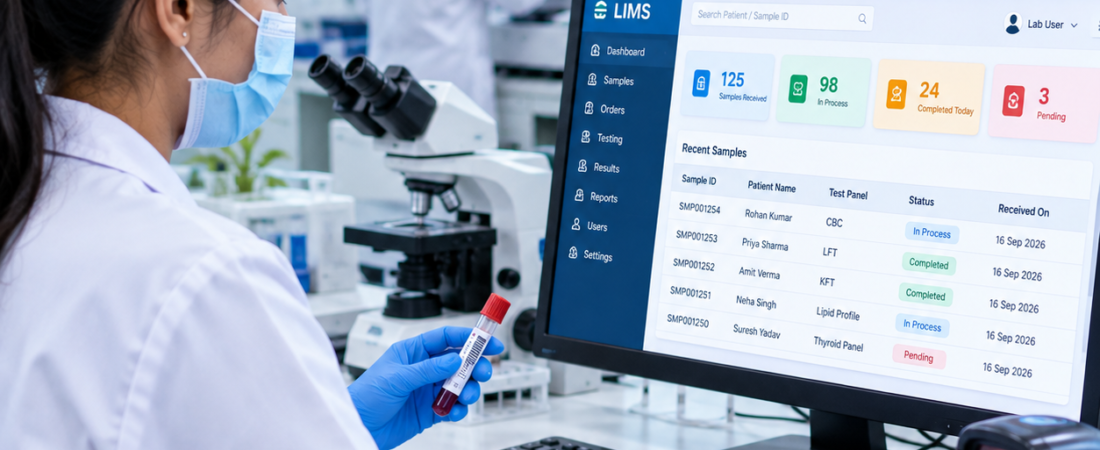
Start with registration. Patient or client information, requested tests and sample details should be captured in a structured workflow. From there, accessioning and sample identification should keep the physical specimen connected to the correct digital record.
Barcode support is useful when a laboratory wants stronger identification and tracking. PathXprt describes barcode tracking as a way to connect samples with patient and test records and support accurate identification. PathXprt.
Then test what happens after registration. Can staff see which samples are pending? Can a result move through the required review or verification stage? Can an approved report be dispatched without staff having to rebuild the information somewhere else?
[INTERNAL LINK: LIMS sample tracking and barcode management]
Result entry is only half of the result workflow
This is where buyers should slow down.
Ask the vendor to demonstrate a normal result, then deliberately change it. What happens to the original value? Who is allowed to make the correction? Is the change visible in the audit history? Can the corrected result go through the appropriate verification and approval process?
Kenya Ministry of Health procurement requirements for laboratory information systems place emphasis on system integration, training, data conversion and migration, among other implementation requirements. These requirements are a useful benchmark when evaluating a commercial LIMS, even when the buyer is not purchasing through the Ministry. Kenya MoH KNPHI LIMS requirements.
A vendor that only shows the happy path has not shown you enough.
What should a LIMS integrate with?
Do not accept “we support integration” as an answer.
Ask exactly what needs to connect to the LIMS: laboratory analyzers, hospital systems, reporting platforms, billing, communication tools or other applications. Then ask what data moves in each direction and how the system behaves when a connection fails.
Kenya’s Ministry of Health has separately published requirements for a comprehensive national LIMS that include system integration and supplier-provided training and data migration services. That is a strong reminder that implementation is part of the software decision, not something to discuss after purchase. Kenya MoH national LIMS procurement.
For an Isiolo laboratory, put your actual instruments and connected systems on the demo checklist. A generic integration slide is not enough.
Security and user permissions should be demonstrated, not promised
Laboratory systems contain sensitive information, so access needs to match responsibility.
Ask the vendor to create different user roles during the demonstration. Show what a front-desk user can see. Then show what a laboratory technician can change. Finally, check what an authorized reviewer or administrator can approve or modify.
PathXprt states that its platform supports role-based access and controlled user permissions. It also describes secure communication and centralized laboratory data management. These are vendor claims and should be verified during a product demonstration against your own requirements. PathXprt About Us.
Connectivity deserves a real test in the demo
A cloud-based LIMS looks great when the internet is working. Your evaluation should include the opposite situation.
Ask what happens if the connection drops while staff are entering or sending information. How are failed transmissions shown? What happens to pending work? What is the recovery process?
The Kenya Laboratory Capacity Mapping Report specifically assessed reliable, dedicated internet connectivity as one of the laboratory data-management indicators. Again, that is historical national evidence, not a current measurement of every laboratory in Isiolo. It does, however, justify making connectivity part of the buying conversation rather than treating it as an afterthought.
What makes PathXprt worth putting on the shortlist?
PathXprt is designed around the complete laboratory workflow, from patient registration and sample collection to processing, verification, reporting and result delivery. Its published feature set includes order management, sample collection, accessioning, inventory, reporting, barcode support, laboratory analytics and equipment interfacing. PathXprt LIMS.
It also supports multi-location management, which matters for diagnostic groups operating more than one branch or coordinating with partner laboratories.
But do not choose PathXprt simply because this article recommends it.
The fair test is to put PathXprt and competing LIMS products through the same scenario. Use a real sample journey from your laboratory. Ask each vendor to demonstrate registration, collection, accessioning, result entry, verification, reporting and dispatch. Then introduce an exception: a corrected result, rejected specimen, permission restriction or integration failure.
That comparison gives you evidence instead of marketing language.
[INTERNAL LINK: PathXprt LIMS features]
Who should not buy a full LIMS?
A full LIMS is not automatically the right answer for every small laboratory.
If your operation only needs a very basic record-keeping tool and has no requirement for controlled workflows, sample traceability, structured reporting or integrations, a larger system may introduce complexity you do not need.
The opposite mistake is just as common: choosing a cheap tool because its feature list looks sufficient, then discovering that critical workflows still have to be managed in spreadsheets, paper registers or separate applications.
Use this checklist before choosing a LIMS in Isiolo
- Run one real sample from registration through final report.
- Test barcode or sample identification workflows where required.
- Demonstrate result verification, approval and correction history.
- Check user roles and permissions using real staff responsibilities.
- Ask which analyzers and external systems are supported by actual integration.
- Test what happens during a connectivity interruption.
- Review backup, security, audit and data-retention requirements.
- Ask what implementation, training and migration support is included.
- Compare vendors using the same workflow rather than different sales demos.
The practical recommendation
If your laboratory in Isiolo is actively evaluating LIMS software, shortlist systems that prove the complete workflow instead of simply presenting the longest feature list.
PathXprt is a sensible product to include in that comparison because its published platform covers the core journey from registration and sample collection through laboratory processing, reporting and delivery.
Before making the final decision, request a demonstration using your own laboratory workflow. Bring the sample types, reporting requirements, user roles and integrations you actually expect to use. If the system handles those scenarios cleanly, you have something much more useful than a brochure: evidence that the LIMS fits your laboratory.
Request a PathXprt LIMS Demo
Tell us about your laboratory workflow, the tests you run and the systems you need to connect. The demo should be built around your requirements.