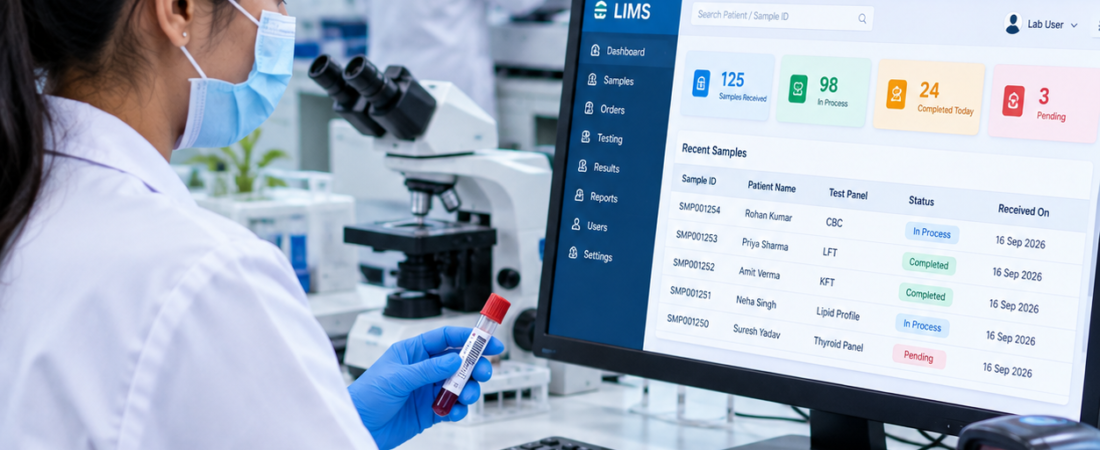
If you are looking for the best LIMS software in Kiambu, Kenya, the shortlist should start with workflow—not marketing claims. For a diagnostic or pathology laboratory, the real test is whether the software takes a patient from registration and sample collection through testing, verification, reporting and billing without forcing staff back into paper or spreadsheets.
PathXprt is a strong candidate to evaluate alongside Kenya-based alternatives. Its published LIMS functionality covers patient and order management, sample collection, accessioning, barcode workflows, laboratory equipment interfacing, reporting, approvals, dispatch, finance and multi-location operations. But Kiambu buyers have another useful option to investigate: IMARA LIMS is based in Ruiru, Kiambu, and positions itself as an enterprise LIMS for clinical, analytical and other laboratory environments. PathXprt IMARA LIMS
What is a laboratory buyer in Kiambu actually trying to fix?
The software is only the tool. The problem is usually the workflow around it.
A laboratory wants to know where a sample is, who has worked on it, whether a result has been checked, whether the report has been released and whether the corresponding test has been billed. If those answers require calling another department or opening another spreadsheet, the LIMS has not solved the whole problem.
Kenyan LIMS procurement requirements give a useful benchmark. KRA’s technical specification calls for configurable and scalable LIMS capabilities and includes remote sample collection, web access to laboratory data and reports, process-flow evaluation, configuration, validation, training and maintenance. KRA LIMS technical specification
What do the competing LIMS pages already cover?
Most Kenya-focused laboratory software pages cover the same table stakes: sample registration, barcodes, worklists, result entry, result verification, reporting, analyzer integration, billing, inventory and audit trails.
E-Afya LIMS, for example, publishes barcode sample tracking, analyzer results, worklists, verification, report delivery, billing and reagent stock management. It also describes support for hospital laboratories, standalone diagnostic labs and collection-centre networks in Kenya and Africa. E-Afya LIMS citeturn0search1
Matokeolab promotes browser-based operation, offline capability, M-Pesa billing, result revision history, audit trails and analyzer data import. Matokeolab citeturn0search0
IMARA LIMS is particularly relevant to this search because its published contact information places it in Ruiru Town, Kiambu, Kenya. Its site positions the platform for clinical and medical laboratories as well as analytical, quality, research and other laboratory types. IMARA LIMS citeturn0search5
So the buyer is not short of feature lists.
What is missing from most “best LIMS” comparisons?
The missing piece is a proper buying test.
A laboratory manager does not need another paragraph saying that a product has “sample management.” The useful question is much narrower: can the vendor show the complete history of one sample, including collection, processing, result entry, verification, release and any correction?
Then break it.
Reject the sample. Correct a result. Add a repeat test. Outsource one investigation. Ask who can see the change. Check whether billing follows the order. That is where two systems that looked identical on a sales page start behaving very differently.
Why PathXprt belongs in the Kiambu comparison
PathXprt publishes a workflow covering order management, patient registration, sample collection, accessioning, barcode printing and scanning, sample segmentation and outsourcing, quality checks, archiving, reporting, approval workflows, dispatch, finance, dashboards and multi-location support. PathXprt LIMS features
That makes it worth testing for laboratories that want the laboratory workflow and business side of the operation in the same system.
The multi-location point deserves a real demonstration if your laboratory works with collection centres, branches or referral locations. Do not accept a screenshot of a dashboard. Ask the vendor to create an order at one location, move the specimen through the laboratory workflow and show exactly where the result and financial record appear.
[INTERNAL LINK: multi-location LIMS for diagnostic laboratories]
What should you test during the LIMS demo?
Start with a normal patient.
Register the patient. Add the requested investigations. Create the order. Collect and identify the sample. Route it to the appropriate worklist. Enter or import the result. Send it for verification. Release the report. Then check the bill.
That is the easy part.
Now ask the vendor to demonstrate a rejected sample. What status does it receive? Who is notified? What happens to the test order?
Change a result after it has been entered. Can an authorised user do it? Does the previous result remain visible? Is the person and time recorded?
Repeat the exercise with an outsourced test. Finally, search for the patient’s previous results and check whether the current report can be compared with earlier records.
Sample tracking should show the whole journey
Barcode printing is useful, but barcode printing alone is not sample traceability.
PathXprt publishes barcode support, accessioning, sample tracking, quality checks, archiving and workflow notifications. PathXprt sample management
Ask the vendor to open a completed sample and show its history from registration through release. If you cannot understand what happened to the sample from that screen, keep asking questions.
Analyzer integration needs a real instrument test
Every vendor can say “analyzer integration.” The useful question is whether it works with the equipment in your laboratory.
Give the vendor the exact analyzer manufacturer and model. Ask how results enter the LIMS, how patient/sample matching is handled and what happens when an import contains an error or unexpected value.
This matters because manual transcription is one of the places where a digital workflow can quietly become a manual workflow again. E-Afya and Matokeolab both publish analyzer-integration capabilities, while Matokeolab specifically describes importing analyzer CSV/Excel runs. citeturn0search1turn0search0
Reporting should be tested with your report, not theirs
A polished demo report proves very little.
Take one of your laboratory’s actual report formats and ask the vendor to reproduce it. Then ask for a corrected result and see how the report changes.
PathXprt publishes custom report templates, digital report generation, bulk reporting, speech-to-text entry and an error-checking engine. Those are published product claims, so verify the specific functions during the demonstration.
Kiambu buyers have a local LIMS option too
This is where the Kiambu comparison differs from a generic Kenya LIMS article.
IMARA LIMS lists Ruiru Town, Kiambu, Kenya as its location and markets its system across clinical and medical laboratories as well as analytical and quality environments. Its site also highlights areas such as sample management, automation and laboratory operations. IMARA LIMS citeturn0search5
That local presence is worth considering, but location should not decide the purchase by itself. Ask the same questions of IMARA, PathXprt and any other serious vendor: show the patient-to-report workflow, demonstrate your analyzer integration, test result corrections and show the audit trail.
There is also evidence that LIMS deployments already operate in the wider Kiambu area. OasisLIMS lists client locations in Nairobi and Thika, Kenya, and describes its platform as supporting laboratory operations across multiple countries. citeturn0search3turn0search4
That gives a buyer more than one type of option: a locally based Kiambu vendor, Kenya-focused laboratory platforms and broader international LIMS products.
Should you buy a LIMS or a full HIMS?
Look at what the laboratory actually needs to own.
If the facility is a hospital and laboratory orders need to connect tightly with OPD, inpatient care, pharmacy, billing and the patient record, a HIMS with a strong laboratory module may be the better architecture.
If the organisation is primarily a diagnostic laboratory, judge the depth of the LIMS workflow first. A bigger hospital system is not automatically a better laboratory system.
For either choice, insist on a live workflow demonstration.
Security and Kenyan health-data requirements should be tested
Laboratory software processes health information. Security therefore belongs in the purchasing conversation, not just the IT checklist.
Kenya’s 2026 National Public Health Institute LIMS documentation states that the Kenyan legal and regulatory framework includes the Data Protection Act, 2019 and calls for safeguards including role-based access, user authentication and audit trails for patient and specimen data. citeturn0search40
Ask the vendor to demonstrate user roles, authentication, audit history, access controls, backups, data export and what happens to a user’s access when that employee leaves.
PathXprt publishes role-based access, encrypted communication and traceability as part of its security positioning. Treat those as vendor claims to be checked during your technical review rather than assuming that a product description equals a compliance certification. PathXprt security information
Who should choose PathXprt—and who should not?
PathXprt is worth serious evaluation if you want patient and order management, sample workflows, reporting, result approvals, finance and multi-location capabilities in one LIMS platform.
It is not automatically the right answer for every organisation.
A highly specialised research laboratory, an organisation with unusual instrument requirements or a facility needing a very specific regulatory workflow should ask the vendor to prove those requirements before buying. If the demonstration does not cover them, compare a specialist or enterprise LIMS.
The five questions I would ask every Kiambu LIMS vendor
- Can you reproduce our complete patient-to-report workflow using our real tests?
- Can you demonstrate integration with our actual analyzer models?
- What happens when a sample is rejected, a result is corrected or a test is repeated?
- Can you show the audit trail and permissions for each laboratory role?
- What exactly is included in implementation, migration, training, support, upgrades and integrations?
So, what is the best LIMS software in Kiambu?
There is no independently verified ranking that makes one LIMS objectively the best for every laboratory in Kiambu.
The shortlist should include PathXprt, plus other products that pass the same workflow test. Kiambu buyers have the additional option of evaluating a locally based product such as IMARA LIMS, while Kenya-focused systems such as E-Afya and Matokeolab provide other approaches to laboratory automation. citeturn0search0turn0search1turn0search5
My recommendation is simple: do not buy from the feature sheet. Give each shortlisted vendor the same patient, sample, analyzer, report and billing scenario. Then introduce a rejected sample and a corrected result.
The LIMS that handles the real work clearly—and leaves your staff with fewer manual workarounds—should move to the final procurement stage.
Want to test PathXprt with your laboratory workflow? Request a PathXprt demo.