Best LIMS Software in Shalimar Bagh: A Practical Guide
Best LIMS software in Shalimar Bagh can help diagnostic laboratories and pathology centers replace repetitive manual processes with a more organized digital workflow. From registering patients and collecting samples to managing tests, verifying results, and preparing reports, a Laboratory Information Management System can connect important laboratory activities in one place.
This guide is written for pathology labs, diagnostic centers, clinical laboratories, sample collection centers, laboratory owners, administrators, and healthcare businesses in and around Shalimar Bagh, Delhi that are evaluating LIMS software for their operations. It is especially useful when you are replacing paper registers or spreadsheets, opening a new collection centre, adding more tests or branches, or trying to bring patient registration, sample tracking, reporting and billing into one workflow. Before choosing a system, review how your staff actually work today and use that workflow as the basis for a demo and vendor comparison.
For related guidance, see our laboratory sample tracking system guide and LIMS software guide for India.
If your laboratory is still using paper registers, spreadsheets, or separate applications for different activities, a centralized LIMS can help bring these workflows together. However, software should be selected according to actual operational requirements rather than simply choosing a product because it has a large number of features.

Table of Contents
- What Is LIMS Software?
- Why Do Laboratories in Shalimar Bagh Need LIMS?
- What Features Should the Best LIMS Software Include?
- Patient Registration and Management
- Sample Tracking and Barcode Management
- Test and Result Management
- Digital Laboratory Reports
- Billing and Laboratory Management
- 7 Benefits of LIMS Software
- How to Choose LIMS Software in Shalimar Bagh
- Cloud-Based vs On-Premise LIMS
- PathXprt LIMS
- Frequently Asked Questions
- Conclusion
What Is LIMS Software?
A Laboratory Information Management System provides a structured way to manage laboratory information. Instead of depending completely on paper files or disconnected spreadsheets, authorized users can work with centralized digital records.
Depending on the product, LIMS can support patient registration, sample identification, barcode tracking, test management, result entry, verification, report generation, billing, dashboards, and other laboratory activities.
Laboratory quality also depends on organized processes and reliable information management. The WHO Laboratory Quality Manual provides useful information about laboratory quality practices.
Why Do Laboratories in Shalimar Bagh Need LIMS?
A diagnostic laboratory can handle many activities during a normal working day. Patients need to be registered, tests need to be selected, samples need to be collected and identified, results need to be entered, and reports need to be prepared.
When patient volume increases, manual processes can become harder to manage. Staff may spend more time searching for records, checking sample status, entering repeated information, and preparing documents.
A digital workflow can reduce some of this repetitive work and make information easier to access for authorized users.
- Small pathology laboratories
- Diagnostic centers
- Clinical laboratories
- Sample collection centers
- Multi-branch diagnostic organizations
- Laboratory administrators
- Healthcare businesses planning laboratory automation
What Features Should the Best LIMS Software Include?
When evaluating the best LIMS software in Shalimar Bagh, compare features according to actual laboratory requirements.
| LIMS Feature | Purpose |
|---|---|
| Patient Management | Organizes registration and patient records |
| Sample Tracking | Tracks samples through laboratory stages |
| Barcode Management | Supports sample identification |
| Test Management | Organizes tests, profiles, and packages |
| Result Management | Supports result entry and verification |
| Report Generation | Helps prepare laboratory reports |
| Billing | Manages invoices, payments, and receipts |
| Dashboard | Provides operational information |
| User Roles | Controls access according to responsibilities |
Patient Registration and Management
Patient registration is usually one of the first steps in a diagnostic workflow. A digital system can help staff create structured records and retrieve information when required.
For returning patients, staff may be able to search existing records rather than entering all details again. This can make registration more efficient.
Useful Patient Management Features
- Unique patient ID
- Patient contact information
- Visit history
- Previous test records
- Referring doctor information
- Patient search
- Test history
Sample Tracking and Barcode Management
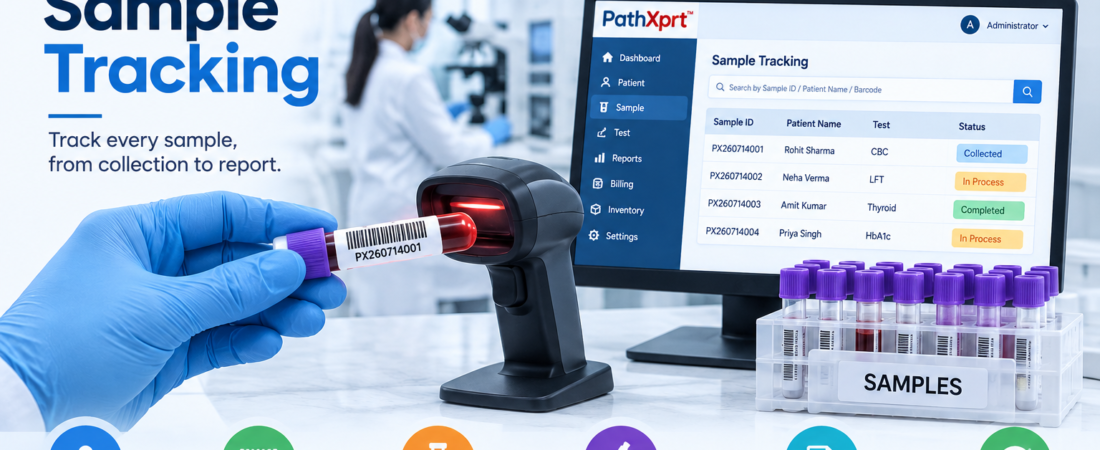
Sample identification is an important part of laboratory workflow. A sample may pass through several stages before the final report is released.
Barcode-based identification can give a sample a unique reference and help authorized staff locate its status within the laboratory workflow.
Typical workflow:
Patient Registration → Test Selection → Sample Collection → Barcode → Processing → Testing → Verification → Report
Test and Result Management
Laboratories may perform routine tests, profiles, packages, and specialized investigations. LIMS can help maintain these services in a centralized system.
Test Management
Depending on the system, test configuration can include test names, departments, sample types, parameters, reference ranges, pricing, and other laboratory-specific information.
Result Entry
Authorized users can enter results against the appropriate patient and sample record. Results can then move through the laboratory’s defined review or verification workflow.
Result Verification
A structured verification process can help laboratories maintain control over the report-release workflow.
Digital Laboratory Reports
Clear reporting is an important part of diagnostic laboratory operations. A LIMS can help maintain standardized report formats and connect results with patient records.
- Patient information
- Test results
- Reference ranges
- Doctor information
- Laboratory branding
- Report templates
- Printing options
- Digital report delivery
Billing and Laboratory Management
Maintaining billing separately from patient and test information can create additional administrative work. An integrated workflow can help laboratory staff manage these activities together.
- Test billing
- Package billing
- Discount management
- Payment recording
- Receipt generation
- Outstanding payment tracking
- Daily collection reports
7 Benefits of the Best LIMS Software in Shalimar Bagh
1. Organized Patient Records
Patient, visit, test, and report information can be maintained in a structured digital environment.
2. Better Sample Visibility
Barcode-based workflows can help staff identify samples and follow their status through laboratory stages.
3. Faster Routine Operations
Digital registration, test selection, and report workflows can reduce repetitive manual data entry.
4. Consistent Reporting
Configured templates can help laboratories maintain a consistent reporting format.
5. Integrated Billing
Connecting laboratory services with billing can make invoice and payment management more organized.
6. Better Operational Visibility
Dashboards and reports can help authorized managers review laboratory activity and operational information.
7. Future Scalability
A scalable platform can support additional users, tests, collection centers, or branches as laboratory operations expand.
How to Choose LIMS Software in Shalimar Bagh
1. Understand Your Current Workflow
List the activities currently handled manually. This may include registration, sample collection, billing, result entry, report preparation, and patient communication.
2. Check Ease of Use
Laboratory staff should be able to learn the system without unnecessary complexity. A clean interface can help improve adoption.
3. Review Sample Tracking
If your laboratory processes many samples, check whether barcode identification and sample status tracking are supported.
4. Review Reporting
Ask whether report templates can be configured according to your laboratory’s workflow and branding.
5. Check User Permissions
Different staff members may need different access levels. Ask how the software manages user roles and permissions.
6. Ask About Support
Review implementation, training, technical support, maintenance, updates, backup, and troubleshooting options.
7. Think About Future Growth
If you expect additional users, collection centers, tests, or branches, confirm whether the software can scale with those requirements.
The CDC laboratory quality resources can provide additional background when evaluating laboratory quality processes.
Cloud-Based vs On-Premise LIMS
Cloud-Based LIMS
Cloud-based systems are generally hosted on remote infrastructure and may use subscription-based pricing. They can be useful for laboratories that want centralized access and managed infrastructure.
On-Premise LIMS
On-premise software is installed within the organization’s infrastructure. It can provide direct control over the local environment but may require additional server and maintenance resources.
How Much Does LIMS Software Cost in Shalimar Bagh?
Small laboratories may require only essential modules such as patient management, sample tracking, testing, reporting, and billing. Larger diagnostic centers may require additional functionality such as multi-branch management, collection center workflows, advanced dashboards, and integrations.
Before purchasing, ask the vendor to clearly explain software fees, implementation costs, customization, hosting, support, training, and recurring charges.
PathXprt LIMS for Laboratories
For laboratories evaluating the best LIMS software in Shalimar Bagh, PathXprt can be considered alongside other solutions based on actual workflow requirements, usability, features, scalability, implementation, and support.
Visit the PathXprt laboratory management software website to explore the platform and its laboratory-focused capabilities.
Looking for a Modern LIMS Solution?
Explore PathXprt and see how a digital laboratory management platform can help organize diagnostic laboratory operations.
Frequently Asked Questions
What is the best LIMS software in Shalimar Bagh?
The right LIMS depends on the laboratory’s size, workflow, test volume, users, reporting requirements, budget, integrations, and growth plans. Laboratories should compare these factors before selecting software.
What does LIMS software do?
LIMS helps laboratories manage information and workflows related to patients, samples, tests, results, reports, billing, and other laboratory activities.
Can LIMS software track laboratory samples?
Yes. Many LIMS platforms provide sample tracking and barcode functionality to help laboratories identify and monitor samples through different workflow stages.
Can LIMS generate laboratory reports?
Yes. LIMS can support result entry, verification, report templates, report generation, and digital report delivery depending on the product configuration.
Is LIMS suitable for small pathology laboratories?
Yes. A properly configured LIMS can help small pathology laboratories organize patient records, samples, testing, reports, and billing while reducing dependence on manual processes.
Can LIMS support multiple branches?
Some LIMS platforms support multi-branch operations. Laboratories planning to expand should confirm branch management and centralized reporting capabilities before selecting a platform.
How much does LIMS software cost in Delhi?
LIMS pricing varies according to users, modules, deployment, customization, integrations, support, and other requirements. Laboratories should request a quotation based on their specific workflow.
Conclusion
The best LIMS software in Shalimar Bagh should help a laboratory manage its daily workflow in a structured and practical way. Patient registration, sample tracking, testing, result verification, reporting, billing, and user management are some of the key areas to evaluate.
For pathology labs and diagnostic centers in Shalimar Bagh, the decision should be based on actual operational needs rather than only software price or the number of advertised features.
A live demonstration, workflow review, feature comparison, and discussion about implementation and support can help laboratory owners make a more informed software selection.