
How to Start a Pathology Lab in India in 2026
Quick answer: To start a pathology lab in India, choose between a sample collection centre and a testing laboratory, verify state and local permissions, arrange qualified staff and report authorisation, plan equipment around your test menu, budget working capital, and set up quality procedures and lab software before accepting samples.
Who this guide is for: Healthcare entrepreneurs, laboratory technicians planning a business, and existing collection-centre operators who need a practical setup, licensing, cost-planning, and software checklist.
At a glance: Decide the model and test menu first; confirm rules with the relevant state authority; obtain written equipment and premises quotations; plan monthly cash flow; and test the complete sample-to-report workflow before launch. Requirements and fees vary by location and services.
1. Which type of pathology business should you start?
Short answer: A collection centre sends samples to a partner lab, while a testing laboratory performs tests on site. Choose based on your budget, expertise, test menu, and local compliance requirements.
First, choose between two operating models.
Sample collection centre
You collect and label patient samples, maintain the required storage and transport conditions, and send them to a partner laboratory for testing. This model reduces the need to purchase a full range of analysers, but it depends on a reliable reference-lab agreement, clear sample-transport procedures, and transparent reporting arrangements. Confirm the registrations and permissions applicable to your exact setup before opening.
Full pathology testing laboratory
You perform some or all tests on your own premises. That means planning a suitable work area, equipment, reagents, quality control, trained staff, biomedical-waste handling, and qualified report authorisation. The test menu determines much of the setup: a lab offering routine haematology and biochemistry has different requirements from one performing microbiology, histopathology, or specialised testing.
Practical recommendation: start with a defined test menu and a written plan for tests you will refer elsewhere. Add equipment only when expected sample volume, quality requirements, and operating costs justify it.
2. How much does pathology lab setup cost in India?
Short answer: Setup cost varies with location, premises, equipment, test menu, staffing, compliance, and working capital. Build a budget from local written quotations instead of relying on one online estimate.
There is no single reliable price for every Indian lab. Your pathology lab setup cost depends on the city, rent and deposit, renovation, equipment condition, test menu, staffing, compliance requirements, and working capital. Online guides publish different ranges because they assume different lab sizes and services; treat them as planning examples, not official quotations.
Build a budget using these headings before you commit:
- Premises: deposit, rent, electrical work, plumbing, benches, ventilation, signage, and storage.
- Equipment: analysers, microscope, centrifuge, refrigerator, pipettes, and any instruments required for the selected tests.
- IT and reporting: computers, printer, barcode or label printer if needed, secure backups, internet, and laboratory information system (LIS) software.
- Opening stock: reagents, calibrators, controls, collection tubes, PPE, and other consumables.
- Compliance and professional services: applicable registrations, waste-management arrangements, accounting, and specialist advice.
- Working capital: rent, salaries, utilities, reagent replenishment, equipment servicing, and transport during the initial months.
Request written quotations from more than one equipment supplier. For refurbished equipment, ask about service support, calibration, parts availability, warranty, and reagent costs. A lower purchase price is not a bargain if downtime or proprietary consumables make each test expensive.
Prepare three scenarios—conservative, expected, and high-volume. Estimate monthly fixed costs, variable cost per test, average collection per test, referral-lab charges, and the number of paid tests needed to cover expenses. Do not assume that patient volume will immediately match your sales target.
3. Which pathology lab licences and registrations should you check?
Short answer: Check clinical-establishment rules, biomedical-waste requirements, local business permissions, tax obligations, and any approvals linked to your services with the relevant authorities in your state and city.
There is no universal checklist that can be applied unchanged across every state. Start with the state health department or district registration authority and confirm the rules for your exact facility type and services.
- Clinical-establishment registration: check whether the Clinical Establishments (Registration and Regulation) Act, 2010 applies in your state or whether a state-specific law governs the facility. The Ministry of Health and Family Welfare explains the Act’s scope and implementation on its official website.
- Biomedical waste: confirm the authorisation and handling requirements with your State Pollution Control Board or Pollution Control Committee. Ask whether you must contract with an authorised common biomedical-waste treatment facility and what records are required.
- Local business permissions: check business constitution, Shops and Establishments requirements, municipal trade permissions, building use, and fire-safety requirements with the relevant local authorities.
- Tax and employment: ask a chartered accountant which tax registrations apply to your business model, turnover, and services. Do not assume GST registration is automatically required—or automatically unnecessary—in every case.
- Additional approvals: verify any requirements linked to your specific tests, equipment, premises, storage, or services.
Keep copies of applications, approvals, staff credentials, equipment maintenance records, quality-control logs, waste records, and applicable policies in one compliance file. Check renewal dates rather than waiting for an inspection to discover that a document has expired.
Official starting point: Clinical Establishments Act FAQs. This is a starting point for research, not a substitute for confirming current local rules.
4. Who can run the lab and authorise reports?
Short answer: Define qualified staff roles and report-authorisation responsibilities before launch. Verify current qualification rules for your facility type and test menu with the state authority.
Plan professional oversight before opening. Laboratory testing, interpretation, and report authorisation are not interchangeable jobs. The qualifications and responsibilities required depend on the applicable rules, test category, and facility standards. Confirm the current requirements with the state health authority and qualified legal or regulatory adviser; do not rely on a vendor’s verbal assurance.
Depending on your model and test menu, your staffing plan could include qualified laboratory professionals, a pathologist or other appropriately qualified reporting professional, a phlebotomist, and front-desk or operations support. Document each person’s role, qualifications, availability, and responsibility for quality and escalation.
Do not advertise services that your staff, equipment, approvals, or reporting arrangements cannot safely support.
5. What equipment and premises do you need?
Short answer: Choose equipment from the tests you plan to perform, then map safe sample handling, testing, reporting, storage, maintenance, and waste-disposal workflows before finalising the premises.
Make the equipment list from the approved test menu—not the other way around. Routine haematology and biochemistry may require different instruments from microbiology or histopathology. Ask a qualified laboratory professional to define the equipment, controls, consumables, environmental conditions, and maintenance schedule for each test.
Before finalising the premises, map the patient journey: registration, sample collection, sample identification, processing, testing, review, report delivery, and waste disposal. Keep clean and contaminated workflows appropriately separated, provide suitable handwashing and storage facilities, and plan for power interruptions and temperature-sensitive materials.
For every instrument, compare the full cost of ownership: purchase or lease, installation, calibration, service response, consumables, controls, downtime, and staff training. Check whether the supplier supports the workload you expect and whether the instrument can exchange results with your chosen software.
6. Why should you choose lab software before launch?
Short answer: Select and test a laboratory information system before opening so patient registration, sample tracking, results, review, reporting, billing, permissions, and backups follow one consistent workflow.
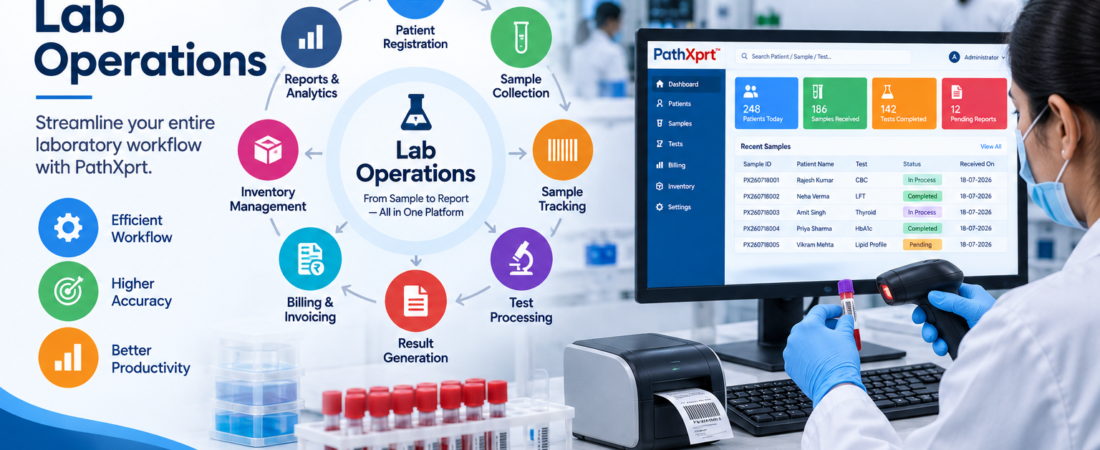
Do not leave the laboratory information system until after the first patient arrives. Even a small operation needs a consistent way to register patients, identify samples, record tests, track pending work, prepare reports, manage billing, and control access to patient information.
When evaluating pathology lab software, ask for a demonstration using your real workflow. Check whether it supports:
- Patient registration, unique IDs, test catalogues, and configurable rate lists.
- Sample labels or barcodes and visibility of pending, rejected, or completed samples.
- Report templates, reference ranges and units configured for the relevant test and method, plus an appropriate review and authorisation workflow.
- Billing, receipts, referring-doctor or partner-lab workflows where applicable, and digital report delivery with suitable access controls.
- Audit trails, user permissions, backups, data export, support, and analyzer integration where compatible.
Ask the vendor to demonstrate what happens when a sample is rejected, a result needs correction, a user leaves the organisation, or the internet goes down. Confirm how patient data is backed up and restored. A feature list is less useful than seeing these exceptions handled correctly.
PathXprt is designed for laboratory management workflows. Explore the relevant PathXprt website and arrange a demonstration to assess fit against your own test menu and processes. laboratory sample tracking system helps teams follow specimens through collection, processing, and reporting. For billing workflows, review pathology lab billing software with GST. To evaluate a platform against your own workflow, request a PathXprt LIMS software demo.
7. How do you build a diagnostic centre business plan?
Short answer: Forecast demand, pricing, test mix, staffing, referral-lab charges, fixed costs, and working capital. Track actual sample volume and margins after launch and revise the plan using real data.
A diagnostic centre business plan should explain how the lab will earn enough to cover its costs without compromising quality. Include a local competitor review, target patient groups, expected test mix, pricing, referral relationships, collection-centre partnerships, home collection if offered, staffing, operating hours, and a realistic cash-flow forecast.
Estimate demand using evidence you can actually collect: nearby clinics and hospitals, local population and access, competitor services, conversations with potential partners, and the test menu people request. Avoid building the forecast around informal promises of referrals.
Track sample volume, revenue per test, reagent consumption, repeat or rejected samples, turnaround time, report corrections, pending payments, and monthly operating costs. These figures help identify whether a problem comes from low demand, pricing, wastage, delayed reporting, or an inefficient workflow.
For quality, review the applicable standards and consider whether NABL accreditation is appropriate for your objectives and scope. NABL lists medical-laboratory accreditation under ISO 15189; see its official information. Verify the current criteria directly with NABL before budgeting or applying.
8. Mistakes that make a new lab harder to sustain
Buying too much equipment too soon. Start with a defined menu and a demand forecast. Outsourcing specialised tests can be a sensible early operating choice when quality, transport, turnaround time, and margins are acceptable.
Signing a lease before checking compliance. Confirm that the proposed premises can be used for the intended activity and meet relevant local requirements before committing to renovation.
Underestimating working capital. A lab needs cash for salaries, rent, consumables, servicing, waste handling, and transport even while patient volume is building.
Choosing software on price alone. Test the actual registration-to-report workflow, permissions, backups, support, and instrument compatibility before deciding.
Confusing accreditation with registration. Regulatory registration and accreditation serve different purposes. Confirm which legal approvals are required to operate and separately evaluate whether accreditation is suitable for your business and clients.
Frequently asked questions
How to start a pathology lab in India with a limited budget?
Compare a compliant sample collection-centre model with a small testing lab. Build a test menu and cash-flow plan first, and verify the permissions required for the selected model. Do not reduce spending on qualified oversight, sample handling, quality control, or legal compliance.
Is there one pathology lab licence for all of India?
No single checklist should be assumed to cover every state and facility. Clinical-establishment laws, local permissions, and requirements connected to the services offered must be checked for the actual location.
Is NABL accreditation the same as a licence?
No. NABL accreditation relates to a laboratory’s competence against the applicable accreditation criteria. It does not replace the legal registrations and permissions required for the facility to operate.
What does “pathology lab kaise khole” mean in practical terms?
Choose the lab model and test menu, verify qualifications and local permissions, prepare the premises, arrange equipment and trained staff, establish quality and waste-handling procedures, configure lab software, and test the complete workflow before accepting routine samples.
Your next step
Before paying an equipment advance or signing a long lease, write down your city and state, proposed model (collection centre or testing lab), first-year test menu, available budget, and reporting arrangement. Use that one-page brief to confirm compliance with the relevant authority and request comparable supplier quotations. That is a safer starting point than buying machines first and working out the business afterwards.
Sources and further reading
- Ministry of Health and Family Welfare — Clinical Establishments Act overview
- Ministry of Health and Family Welfare — Clinical Establishments FAQs
- NABL — accreditation and international recognition
Editorial note: This article is general business information, not legal, tax, or medical advice. Requirements can change and vary by state, city, facility type, and test menu. Confirm the current rules with the relevant authorities and qualified advisers before operating.