
Multi-Location LIMS Software for Diagnostic Chains
Bottom line: Multi-location LIMS software should connect collection centres, branches and reference laboratories while keeping sample routing, user permissions, inventory, billing visibility and consolidated MIS under defined central governance.
Who this is for: Diagnostic-chain owners, laboratory directors, operations teams, IT managers and procurement teams comparing LIMS for multiple locations.
A multi-location LIMS should do more than give each branch its own login. For a diagnostic chain, the useful architecture is a shared laboratory platform that can coordinate collection centres and branch laboratories with a central or reference laboratory while preserving location-level control, sample traceability, inventory visibility, billing data and consolidated management reporting.
That distinction matters as diagnostic networks expand. Third-party LIMS market research discusses multi-site and networked laboratory operations, data standardization, interoperability and implementation as relevant market considerations. Mobility Foresights India LIMS market research.
The supplied research brief uses Tata 1mg’s FY26 diagnostics expansion as a market signal. The original BW Healthcare World report should be checked directly before reusing any exact city or laboratory count. This is an example of network scale, not evidence that every diagnostic chain needs the same LIMS architecture.

What should a diagnostic chain look for in multi-location LIMS software?
Start with the laboratory network, not the feature list.
A single pathology laboratory usually needs patient registration, sample accessioning, testing, result validation and reporting. A multi-centre chain has another layer: where the sample originated, where it is being processed, who is allowed to see it, where inventory is held, which branch generated the billing activity, and how central management sees the combined operation.
That is why a chain should evaluate a LIMS against real hub-and-spoke scenarios rather than asking whether it supports “multiple users” or “multiple branches.”
What is Multi Location LIMS Software?
Multi-location LIMS software is a laboratory information management system designed to coordinate more than one laboratory location or collection centre from a shared operational environment.
In a useful implementation, the system can maintain an organization-level view while applying location-specific controls. A central administrator may need visibility across the network. A branch user may need access only to permitted patients, samples and operational functions. A pathologist may need result-review permissions that are different from those of a collection-centre operator.
The exact architecture varies by product. Before buying, ask the vendor to show whether the locations are genuinely managed within one organizational model or are simply separate accounts connected through reporting.
Single-lab LIMS vs multi-branch LIMS vs diagnostic-chain LIMS
| Model | Typical requirement | What to verify |
|---|---|---|
| Single-lab LIMS | One laboratory and one operating location | Core sample, testing and reporting workflow |
| Multi-branch LIMS | Several locations with similar local workflows | Location permissions, branch reporting and shared administration |
| Diagnostic-chain LIMS | Collection centres, branches and one or more reference labs | Sample routing, central processing, inventory, finance and consolidated MIS |
A chain can have ten locations and still operate ten isolated systems. That is not necessarily a centralized multi-location architecture.
Why are separate branch LIMS systems difficult to manage?
Imagine a chain with Branch A, Branch B and a Central Reference Lab.
Branch A registers a patient. Branch B uses a different test master. Both branches create similar patient records. Samples referred to the central laboratory are tracked through calls or spreadsheets. Inventory is counted separately. Management receives monthly files from each location and combines them manually.
The software may technically be “working” at every branch. The network is still fragmented.
Common consequences include:
- Duplicate or inconsistent master data
- Different accessioning practices
- Limited visibility into referred samples
- Separate user administration
- Fragmented stock information
- Difficulty comparing branches
- Delayed consolidated reporting
- Weak visibility into location-wise billing activity
A multi-location LIMS should reduce these coordination problems without removing the operational control that each site needs.
How does a hub-and-spoke LIMS model work?
A typical hub-and-spoke diagnostic workflow can look like this:
Collection centre / spoke → local registration and accession → barcode/sample identification → dispatch or referral → central/reference laboratory → testing → validation → report release → report available to originating location/patient
Not every organization uses this exact model. Some branches perform their own testing; some tests go to a central lab; some specialized investigations may be routed elsewhere.
The LIMS therefore needs to represent the actual network rather than assuming every sample follows one route.
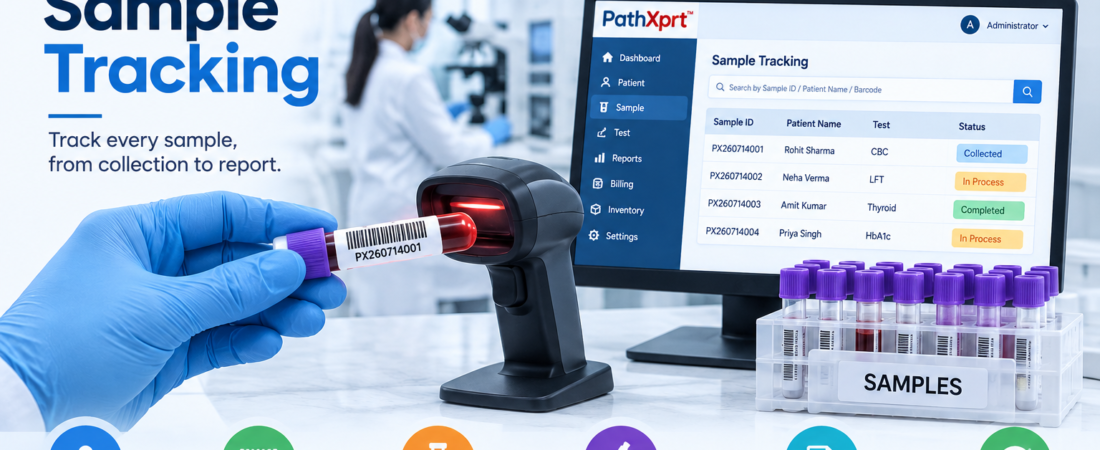
Laboratory Sample Tracking System
1. What should central reference laboratory management include?
The reference laboratory is often where a multi-location LIMS proves whether its architecture is genuinely useful.
The central team may need to see samples arriving from many originating locations, allocate or track work, monitor pending investigations and manage the testing and reporting process.
Before buying, demonstrate:
- Originating-location identification
- Central sample visibility
- Referral and routing status
- Work allocation
- Pending-sample visibility
- Result validation and report release
- Ability to trace the sample back to its originating centre
Do not assume that a central dashboard means the system has a true reference-lab workflow. Ask the vendor to follow one real sample from a spoke to the reference lab.
2. How should spoke and branch accessioning work?
At the spoke, the workflow should be simple enough for collection-centre staff to use correctly.
The LIMS may need to capture the originating location, patient details, requested tests, sample type, collection information and unique sample identifier. Barcode-based identification can then connect the physical specimen with the electronic record.
The important part is what happens after accessioning.
If the sample is going to another location, the system should make its referral or dispatch status visible according to the organization’s workflow.
Ask the vendor to demonstrate:
- Location-specific accession numbering or identification
- Barcode/sample ID generation
- Branch-level user permissions
- Sample collection status
- Dispatch/referral status
- Receiving confirmation at the destination where supported
- Report availability back to the originating location
3. Can the LIMS track a sample between locations?
This is a critical question for a diagnostic chain.
Management should be able to answer:
- Where was the sample collected?
- Where was it accessioned?
- Where was it sent?
- Has the destination received it?
- What is its current processing status?
- Has the result been validated?
- Has the report been released?
The exact routing model will depend on the LIMS and the organization’s logistics process. Do not accept “sample tracking available” as enough evidence.
During the demo, give the vendor a sample collected at Branch A and ask them to show its journey to the Central Reference Lab.
4. How should inventory work across locations?
Inventory becomes a network problem as soon as multiple branches consume the same kits, reagents or collection materials.
A useful multi-location LIMS or connected inventory module may need to distinguish:
- Central stock
- Branch stock
- Kit and reagent quantities
- Transfers between locations
- Consumption
- Minimum stock levels
- Expiry information where supported
- Location-wise stock status
For example, a central warehouse may hold a large quantity of a kit while two collection centres are close to their minimum stock level. Management needs more than a total network quantity; it needs to know where the stock actually is.
Ask whether stock transfers are part of the LIMS, a separate inventory module, or an external ERP integration.
Laboratory Sample Inventory Management System
5. How should role-based access work across branches?
Multi-location access control should reflect organizational responsibility.
A typical chain may have:
- Central administrators
- Branch managers
- Pathologists
- Laboratory technicians
- Collection-centre users
- Finance users
- Senior management
These users should not automatically have identical permissions.
A branch user might need access to that location’s operational records. A central administrator may need network-wide visibility. A pathologist may need result-review rights without receiving unrestricted administrative access.
Ask the vendor to demonstrate both sides:
“Show us what a central administrator can see.”
Then:
“Log in as a Branch A user and show us what that user cannot see.”
That second test is often more revealing.
6. What should consolidated MIS show?
Management reporting is where the value of centralized data becomes visible.
A diagnostic chain may want to compare locations using operational information such as:
- Branch-wise workload
- Test volumes
- Pending samples
- Referral volumes
- Turnaround-time measures
- Inventory status
- Billing or revenue information where integrated
- Other operational KPIs configured by the organization
The exact dashboard should come from management requirements. Do not buy a dashboard because it contains many charts.
Ask whether the numbers are generated from the same operational data that staff use for registration, accessioning, testing and billing.
7. How should finance and billing fit into multi-location LIMS?
A LIMS is not automatically an accounting or ERP system.
That distinction should be made early in procurement.
For a diagnostic chain, useful financial visibility may include:
- Branch-wise billing
- Location-wise test revenue visibility
- Billing permissions
- Centralized reporting
- Discount or rate controls where applicable
- Integration with accounting or ERP software
- GST-related workflows where applicable
Ask which functions are native to the LIMS and which require an external finance or ERP system.
A strong RFP should not simply say “finance integration required.” It should define what data needs to move between systems and in which direction.
What should you check before buying multi-location LIMS software?
Use this checklist during vendor evaluation:
- How many laboratories and collection centres can one organization manage?
- Can new locations be added without creating an entirely separate system?
- Can users be restricted by location and role?
- Can samples move between branches and reference laboratories?
- Can the system show sample origin and current location?
- Can branch-wise inventory be monitored?
- Can stock be transferred between locations?
- Can management see consolidated MIS?
- Can branch-level performance be compared?
- Can billing data be reported by location?
- Can the system integrate with accounting/ERP platforms?
- What APIs or integration options are available?
- How are audit trails handled?
- How is data backed up?
- What is the recovery process after an outage?
- How is data exported if the organization leaves the platform?
- How does pricing change as users, branches or sample volume increase?
What should a multi-location LIMS RFP include?
A chain should avoid an RFP made entirely from generic feature names.
Write operational scenarios instead.
| RFP area | Question to ask |
|---|---|
| Architecture | Can one organization manage multiple laboratories and collection centres? |
| Accessioning | Can the originating location be retained with the sample? |
| Referral | Can a spoke refer a sample to a central laboratory and track its status? |
| Permissions | Can access be restricted by location and role? |
| Inventory | Can stock be viewed and transferred by location? |
| MIS | Can management see consolidated and branch-wise reporting? |
| Finance | Can billing data be separated by location and integrated with finance systems? |
| Integration | What APIs, analyzer interfaces and external-system connections are supported? |
| Continuity | What happens if a branch loses connectivity? |
| Scalability | How is a new branch added? |
| Data ownership | How can the organization export its data? |
| Commercials | How are locations, users, tests and volume priced? |
What should you test during the LIMS demo?
Do not let the demo stay on the dashboard.
Give the vendor three scenarios.
Scenario 1: Branch to reference lab
“Show us a sample collected at Branch A. Register it, generate its identifier, refer it to the Central Reference Lab, receive it there, process it, validate the result and make the report available to the originating location.”
Scenario 2: Permissions
“Show us what the central administrator sees. Then log in as a Branch A user and demonstrate what information and functions are restricted.”
Scenario 3: Inventory transfer
“Show us central stock, Branch A stock and a transfer of a kit from the central location to Branch A. Then show how management sees the updated stock position.”
If a vendor cannot demonstrate the workflow, ask whether the missing step is standard configuration, integration, custom development or unsupported.
What happens when a new branch opens?
This is a good scalability test.
Ask the vendor to explain the actual process for adding a new location:
New location → users → permissions → test/service configuration → sample workflow → inventory → billing → reporting → integration → go-live
You should know which steps your internal team performs and which steps require vendor involvement.
Also ask whether adding the new location changes the subscription, implementation fee or integration costs.
What are the common mistakes in multi-location LIMS selection?
Buying separate branch accounts and calling it centralized
Separate accounts may be useful, but they do not automatically provide shared master data, routing, permissions or consolidated operational control.
Ignoring sample routing
A chain can have excellent local accessioning and still lose visibility when samples move to another laboratory.
Giving every user the same access
Network-wide visibility should not mean unrestricted network-wide permissions.
Ignoring inventory movement
Total stock is not enough. Management needs location-level visibility where multiple branches consume the same materials.
Buying the dashboard before defining the MIS
First define what management needs to measure. Then verify that the source data exists and can be reported consistently.
Ignoring data export
Ask how the organization can retrieve its operational data if the vendor relationship ends or the chain changes systems.
Testing only one branch
A single-site demo cannot prove multi-location behaviour.
Who should choose a multi-location LIMS?
This architecture is worth evaluating for:
- Diagnostic chains
- Multi-branch pathology groups
- Central reference laboratories with collection centres
- Hospital groups operating multiple laboratory units
- Expanding diagnostic networks
A small laboratory with one location and no referral network may not need the additional complexity. A basic single-location LIMS can be the more sensible choice if the operation does not require central governance across sites.
What is the difference between multi-location and multi-user LIMS?
Multi-user means multiple people can use the system.
Multi-location means the system understands that those users and operational records belong to different locations within a larger organization.
That distinction affects permissions, sample routing, inventory, reporting, billing and administration.
Can one LIMS manage multiple pathology laboratories?
Some LIMS products are designed for multi-site operation, but the exact capabilities vary. Ask the vendor to demonstrate organization-level administration, location-level access, sample movement and consolidated reporting rather than relying on the phrase “multi-location supported.”
Can a LIMS connect collection centres to a central reference laboratory?
It can be designed to support such a workflow where the product provides the required accessioning, sample-routing, location tracking and reporting capabilities. The exact process should be tested with the chain’s real workflow.
Can inventory be managed across multiple locations?
Some LIMS products include inventory functionality or integrate with separate inventory/ERP systems. Verify whether the required stock, transfer, consumption and expiry workflows are native, configurable or external.
Can branch-wise reports be generated?
Many LIMS platforms provide reporting and analytics, but the useful question is whether the system can produce the specific branch-wise and consolidated reports the organization needs from standardized underlying data.
Is multi-location LIMS suitable for a growing diagnostic chain?
It can be, particularly when the chain needs central administration while allowing local teams to operate within defined permissions. The purchase should still be based on actual sample-routing, inventory, reporting, finance and integration requirements.
What should be included in a multi-location LIMS RFP?
At minimum, document the organization structure, branch and reference-lab workflows, sample routing, user permissions, inventory, MIS, billing/finance integrations, APIs, security, backup/recovery, data export, implementation responsibilities and pricing as the network expands.
Final recommendation
Key takeaway: Choose multi-location LIMS software by testing the network workflow, not by counting features. A good evaluation should prove sample movement, location-based access, cross-location inventory and consolidated MIS using realistic branch-to-reference-lab scenarios.
For a diagnostic chain, do not evaluate multi-location LIMS software as “the same LIMS installed at many branches.” Evaluate it as a network operating model.
The strongest demo is not a dashboard. It is a real sample moving from a spoke to a central reference laboratory, with the right user permissions, inventory context, billing visibility and management reporting along the way.
Before signing, make the vendor prove four things with your own scenarios: sample movement, location-based access, cross-location inventory and consolidated MIS. Then document what is standard, configurable, integrated and custom.
That approach gives a diagnostic chain a much clearer basis for selecting a LIMS that can grow with the network rather than forcing every new location into a separate software island.
Frequently Asked Questions
Multi Location LIMS Software
What is multi-location LIMS software?
It is a LIMS designed to coordinate laboratory operations across multiple locations or collection centres while maintaining shared governance and location-level controls.
Can one LIMS connect collection centres to a central laboratory?
Yes, where the product supports accessioning, sample routing, location tracking and report workflows. The vendor should demonstrate the complete spoke-to-reference-lab process.
How does multi-location LIMS differ from multi-user LIMS?
Multi-user means several people can use the system. Multi-location means the system understands that users, samples, inventory and operational records belong to different locations within one organization.
Can inventory be managed across multiple diagnostic locations?
Some LIMS products provide inventory functions or integrate with inventory/ERP systems. Verify location-wise stock, transfers, consumption and expiry workflows during the demo.
Can a diagnostic chain get consolidated MIS from LIMS?
A suitable system can provide consolidated and branch-wise reporting, but the required KPIs should be defined before purchase and traced back to standardized operational data.
What should be tested in a multi-location LIMS demo?
Test a real sample from a collection centre to the reference lab, branch-level permissions, an inventory transfer and a consolidated management report. Ask which steps are standard, configurable, integrated or custom.
Claims / Sources to Verify
- Market signal: Mobility Foresights discusses multi-site and networked laboratory operations, centralized oversight, data standardization and multi-site deployment. Treat its market figures as third-party research rather than official industry statistics. Mobility Foresights source.
- Tata 1mg expansion: The supplied brief cites BW Healthcare World for the FY26 diagnostics expansion. Recheck the original article before reusing any exact figure.
- NABL: Verify accreditation-related claims against the official NABL website and current applicable documents. This article does not claim that a LIMS product itself provides NABL accreditation.
- Search volume: The supplied research brief states that search volume was not available on 2026-09-17. No numerical search-volume claim is used.
Research note: The article intentionally focuses on buyer requirements rather than claiming that every LIMS product provides every listed capability. Exact functionality, integration method, pricing and implementation responsibilities must be confirmed with each vendor.