
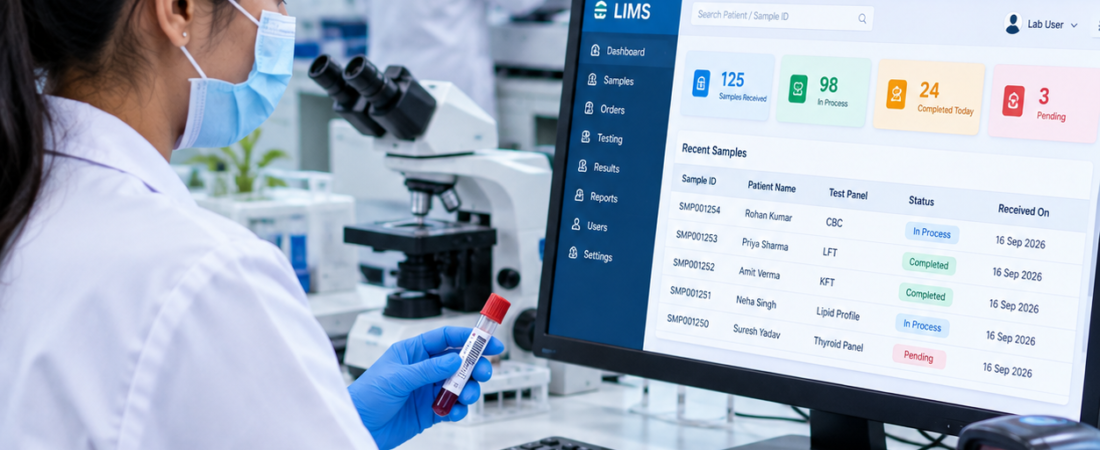
LIMS for Indian Diagnostic Chains India: Scale Without Losing NABL Discipline
Bottom line: A LIMS for an Indian diagnostic chain should standardize test codes and reporting rules, connect branches and reference laboratories, monitor brand-level TAT SLAs, control access by location, and preserve traceable quality records. It can support NABL discipline, but it does not itself create NABL accreditation.
Who this is for: Diagnostic-chain owners, laboratory directors, operations heads, IT teams and managers evaluating LIMS for multiple laboratories and collection centres.
For an Indian diagnostic chain, the LIMS decision changes as soon as the organization has multiple laboratories or collection centres. The software has to keep test definitions consistent, route samples between locations, monitor brand-level TAT expectations, control access by role and location, and preserve quality records without pretending that software itself creates NABL accreditation.
That is the core buying question: can one LIMS give central management a reliable view of the network while allowing each laboratory to operate within defined local controls?
What is LIMS for a diagnostic chain?
A single-laboratory LIMS primarily manages the workflow inside one laboratory. A chain-level LIMS has another responsibility: coordinating multiple operating locations under common rules.
It helps to distinguish four models:
- Single-lab LIMS: designed around one laboratory location.
- Multi-branch LIMS: supports several locations with shared administration or reporting.
- Centralized LIMS: gives a central team control and visibility across the organization.
- Diagnostic-chain LIMS: combines central governance with location-level operations, sample routing, standardized masters, TAT monitoring and network reporting.
A chain does not automatically get centralized management just because every branch has the same software. Ask whether the product actually understands locations, roles, sample movement and organization-level reporting.
Why do diagnostic chains need standardization?
Expansion creates a deceptively simple problem: different teams start making small decisions differently.
One branch calls a test “CBC,” another uses a longer internal name, and a third creates a duplicate code. Report formats start drifting. Reference ranges are maintained differently. Users have different permissions. TAT is measured from different starting points.
The result is a network where the same service may be represented differently in different locations.
A central LIMS governance model can help define common masters and workflows while still allowing legitimate local operational settings.
How should standardized test codes work across branches?
This is one of the first areas to examine during a multi-centre LIMS demo.
Suppose three branches offer the same thyroid test. The chain should have a clear organizational definition of that test. The internal identifier, name, specimen requirements, reporting rules and other applicable configuration should not be reinvented independently at every location.
A practical governance model is:
Central test master → controlled branch availability → local operational use → controlled changes
This does not mean every branch must have an identical test menu. A branch may legitimately offer fewer tests. The point is that the same test should have a consistent organizational definition where the chain intends it to be the same service.
Ask the vendor:
- Can a central administrator maintain the test master?
- Can branches be restricted to approved tests?
- Can test-code changes be controlled?
- Can the system identify duplicate or conflicting codes?
- Can internal codes be mapped to external standards where required?
What is LOINC and why should a diagnostic chain care?
LOINC, or Logical Observation Identifiers Names and Codes, is a standardized terminology used to identify health measurements, observations and related clinical information. Its value in a laboratory context is that standardized identifiers can help systems understand that a laboratory observation represents the same concept even when local names or internal codes differ.
That matters when a diagnostic chain exchanges information between its own systems or with external health-information platforms.
But LOINC should not be treated as a magic switch.
A laboratory still needs governance for mapping. An internal test code does not automatically become a correct LOINC mapping simply because a LOINC field exists in the software.
A useful implementation process is:
- Define the organization’s internal test master.
- Identify tests that need external standardized terminology.
- Map the appropriate observation to the relevant terminology.
- Have a qualified person review the mapping.
- Control future changes to the mapping.
ABDM provides India’s national digital-health infrastructure, so interoperability requirements should be considered alongside the chain’s internal data-governance model rather than treated as a separate checkbox. ABDM official portal.
How should a central lab and collection centre work together?
A realistic chain may have a collection centre that does registration and specimen collection while a central reference laboratory performs specialized testing.
The workflow might be:
Collection centre → accession → barcode/sample identification → dispatch → reference laboratory receipt → testing → validation → report release → report available to originating location
The exact routing depends on the organization. Some branches perform routine tests locally and send only selected investigations to the reference lab.
The LIMS should therefore make the originating location, destination and current sample status understandable.
What should a diagnostic chain expect from branch-level access?
Centralized administration does not mean every user should see everything.
Typical roles may include:
- Central administrators
- Branch managers
- Pathologists
- Laboratory technicians
- Collection-centre staff
- Quality personnel
- Finance users
- Senior management
The exact permission model should follow the organization’s responsibilities.
During the demo, test two accounts:
Central administrator: Can this user see the network and manage permitted organization-level settings?
Branch user: Can this user operate the branch without gaining unauthorized access to other locations?
That test is more meaningful than a generic statement such as “role-based access available.”
What are brand-level TAT SLAs?
A diagnostic chain may make a service promise at the brand level even though the actual work happens across several locations.
For example, a test may be collected at a spoke, transported to a reference laboratory, processed, reviewed and then released to the patient. A chain-level TAT definition needs to make clear what event starts the clock and what event ends it.
A practical TAT model can separate:
- Collection or accession time
- Transportation time
- Receipt at the processing laboratory
- Testing/processing time
- Validation or review time
- Report release time
The organization may define different TAT expectations for different tests or services.
The LIMS can support measurement and reporting, but it cannot guarantee the TAT by itself. Transport delays, staffing, analyzer availability, workload, repeat testing and validation all affect actual performance.
How should a chain monitor TAT across branches?
First define the measurement consistently.
If Branch A starts TAT at sample collection while Branch B starts it at central accession, the comparison is misleading.
Before configuring dashboards, agree on:
- The TAT start event
- The TAT end event
- Test-specific expectations
- How referred samples are measured
- How cancelled or recollected samples are treated
- How exceptions are reported
Then ask the LIMS vendor to show actual-vs-expected TAT reporting across multiple locations.
[YOUR EXAMPLE: describe a real PathXprt or laboratory TAT-governance experience if you have one]
How does NABL discipline change when a chain expands?
Software does not make a diagnostic laboratory NABL accredited.
Accreditation applies to the laboratory’s implemented quality system and applicable scope. A LIMS can support that system by controlling workflows, maintaining records, providing traceability and making evidence easier to retrieve.
For a multi-location organization, the challenge is consistency. A quality process that is controlled at one location should not silently become a different process at another location without an approved reason.
Useful LIMS capabilities to evaluate include:
- Controlled user permissions
- Audit trails for relevant actions
- Traceable sample workflows
- Controlled result review and approval
- Quality records
- Document/version controls where supported
- Evidence retrieval
- Standardized operational workflows
These capabilities support quality discipline. They do not replace laboratory procedures, competency, validation, quality management or the NABL assessment process.
What should central management see in the MIS?
A chain needs more than separate branch reports emailed to headquarters.
Depending on the organization’s requirements, central management may need visibility into:
- Branch-wise workload
- Test volumes
- Pending samples
- Referral volumes
- TAT performance
- Operational exceptions
- Inventory position
- Location-wise performance
Financial reporting is a related but separate consideration. If billing or accounting is handled by another system, the LIMS may need to provide data through an integration rather than acting as the accounting system itself.
How should inventory work across a diagnostic chain?
Multiple locations turn stock management into a network problem.
A chain may need to distinguish central stock from branch stock and understand how kits or reagents move between locations.
Depending on the system, useful capabilities can include:
- Location-wise stock visibility
- Central inventory
- Kit/reagent tracking
- Consumption recording
- Inter-location transfers
- Expiry monitoring
- Minimum-stock or reorder controls where supported
The buyer should establish whether these functions are native LIMS capabilities or require a separate inventory/ERP system.
Laboratory Sample Inventory Management System
How should you evaluate LIMS for an Indian diagnostic chain?
Use this checklist before moving to commercial negotiations:
- Multi-location architecture
- Central reference laboratory support
- Collection-centre workflows
- Standardized test master
- Test-code governance
- LOINC mapping capability where required
- Sample routing and tracking
- Barcode support
- TAT monitoring
- Role-based access
- Consolidated MIS
- Inventory management
- Audit trails
- API/interoperability capability
- Data security
- Backup and recovery
- Scalability for additional locations
- Implementation and support model
- Pricing structure
- Data export and ownership
What should you ask during a LIMS demo?
Do not let the vendor spend the entire demo showing menus.
Test 1: Standardized test governance
“Show us the same test configured across three branches. Now change one controlled setting and show us what happens at the branch level.”
Test 2: Sample movement
“Show us a sample collected at Branch A, routed to the Central Reference Lab, processed there and returned as a released report.”
Test 3: Location permissions
“Show us what the central administrator can see, then show us what the Branch A user cannot access.”
Test 4: TAT
“Show us how the system measures actual TAT against the defined expectation across multiple laboratories.”
Test 5: Standard terminology
“Show us how an internal test code can be mapped to standardized terminology such as LOINC where the use case requires it.”
Test 6: Audit history
“Change an important laboratory record and show us the audit history.”
If the answer is “we can customize that later,” ask whether it is standard configuration, integration, custom development or unsupported.
What are the common mistakes diagnostic chains make?
Choosing a single-lab product because the feature list looks complete
A feature-rich single-lab system can still be a poor fit for a network that needs centralized governance.
Confusing multiple logins with multi-location architecture
Users at different branches do not automatically create a multi-centre LIMS.
Ignoring test-master governance
If branches can independently create conflicting test definitions, consolidated reporting becomes harder.
Treating LOINC as a checkbox
A terminology field without a controlled mapping process does not solve interoperability governance.
Failing to define TAT rules
A dashboard cannot fix inconsistent definitions of when the TAT clock starts or stops.
Assuming software creates NABL compliance
The laboratory still owns its quality system, procedures, competence and implementation.
Ignoring data portability
Ask how the organization can retrieve its data if the vendor relationship ends.
Who should consider LIMS for a diagnostic chain?
This type of architecture is worth evaluating for:
- Growing pathology chains
- Multi-centre diagnostic laboratories
- Central reference laboratories
- Networks operating collection centres
- Hospital groups with multiple laboratory locations
- Organizations planning geographic expansion
A single-location LIMS may be enough for an independent laboratory with no branch network, central referral operation or need for organization-level governance.
Frequently Asked Questions
What is LIMS for a diagnostic chain?
It is a LIMS architecture designed to coordinate laboratory operations across multiple locations, with shared governance and appropriate local controls for samples, tests, users, reporting and other operational workflows.
How is multi-location LIMS different from single-lab LIMS?
Multi-location LIMS adds organizational and location-level controls around the core laboratory workflow, including permissions, sample routing, standardized masters and consolidated reporting.
Can one LIMS manage multiple pathology laboratories?
Some LIMS products support this model. The buyer should verify actual multi-location architecture rather than relying on a “multi-branch” label.
What is the role of standardized test codes?
They provide a controlled internal way to represent tests consistently across locations. A central test master can reduce duplicate or conflicting definitions, subject to the organization’s governance model.
What is LOINC and how can it help diagnostic laboratories?
LOINC is a standardized terminology for identifying laboratory observations and other clinical measurements. It can support interoperability and data exchange where the relevant systems and use cases use LOINC. Correct mapping still requires governance and review.
Can LIMS monitor TAT across multiple branches?
A suitable multi-location LIMS can support TAT measurement and reporting, but the organization must first define consistent start/end events and expectations. Actual TAT also depends on logistics, staffing, workload, instruments and laboratory processes.
Can a diagnostic chain manage collection centres through LIMS?
Yes, where the product supports collection-centre registration, accessioning, sample identification, routing and location-level access. The exact workflow should be demonstrated with a real chain scenario.
Does LIMS make a diagnostic laboratory NABL compliant?
No. LIMS can support controlled processes, records and traceability, but NABL accreditation depends on the laboratory’s implemented quality system, competence, applicable requirements and assessment.
What should an Indian diagnostic chain check before buying LIMS?
Check multi-location architecture, test-master governance, standardized terminology/LOINC where required, sample routing, TAT monitoring, role-based access, MIS, inventory, audit trails, integrations, security, scalability, data export and the vendor’s implementation responsibilities.
Claims / Sources to Verify
- Market context: Mobility Foresights discusses increasing laboratory networks, cloud adoption, interoperability and multi-site deployment as LIMS market considerations. Treat its market estimates as third-party research rather than official statistics. Mobility Foresights market report.
- Diagnostic-chain expansion: The supplied brief identifies BW Healthcare World as the primary source for the FY26 diagnostics-growth story. Any exact city/laboratory figure should be rechecked against the original article before reuse.
- ABDM: Verify current interoperability and digital-health requirements against the official ABDM portal before making any product-specific ABDM claim.
- LOINC: Check the applicable LOINC documentation and the specific interoperability use case before implementation.
- NABL: Any statement about accreditation requirements should be checked against the current NABL documents applicable to the laboratory’s scope. Software capabilities should not be presented as accreditation itself.
- Search volume: The supplied brief states that search volume was unavailable on 2026-09-17, so no numerical search-volume claim is used.
[YOUR REAL EXPERIENCE PLACEHOLDER: Add a genuine PathXprt implementation example here only if you have one, such as a real multi-location test-master, sample-routing, TAT or permissions problem and how it was handled. Do not add a customer name, metric or outcome unless you can verify it.]