Best LIMS Software in Lamu Kenya
Key takeaway: The best LIMS software in Lamu Kenya is the system that fits the laboratory’s real sample-to-report workflow, provides traceability and controlled access, supports required integrations, and is practical for the team to use.
This guide is for laboratory owners, managers, pathologists, quality teams, hospital administrators and IT/procurement teams in Lamu who already understand basic laboratory operations and are evaluating software for diagnostic laboratories, hospital laboratories or clinics. The goal is practical: shortlist a system, run a useful demo, and avoid buying features your team will never use.
What should a LIMS actually solve for a laboratory in Lamu?
A LIMS is software that manages laboratory samples, test workflows, results, reporting, users and related laboratory information in one controlled system. A useful LIMS should make the movement of a sample visible from registration through testing, review and final reporting.
Kenya’s current national laboratory procurement requirements provide a useful benchmark. The Ministry of Health specifies areas such as sample reception and registration, test assignment, sample tracking, quality control, data storage, result review and approval, and reporting. The same documentation also calls for user administration, access control, audit trails, security, backup and disaster recovery. Kenya Ministry of Health LIMS requirements.
That is a better starting point than asking a vendor, “How many modules do you have?”
What are the essential LIMS features to compare?
Short answer: Compare sample registration and tracking, result entry and approval, quality control, auditability, reporting, user permissions, integrations, connectivity and implementation support.
Start with the workflow, not the sales brochure.
Sample registration and tracking
The system should give every sample a clear identity and status. Staff should be able to see what was received, which tests were requested, where the sample is in the process and what remains outstanding.
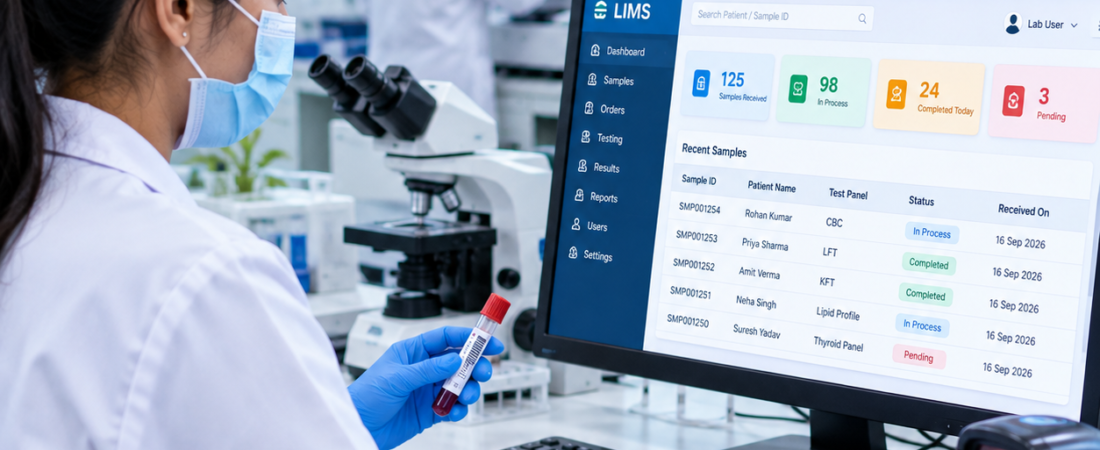
For a laboratory evaluating software in Lamu, ask the vendor to demonstrate a complete sample journey rather than showing screenshots of a dashboard.
Result entry, review and approval
Short answer: Results need controlled entry and a defined review process, with a traceable history when a result is corrected.
A good demonstration should show what happens when a result is changed after initial entry: who changed it, what was changed, when it happened and whether the previous value remains traceable.
This is where a polished interface stops being enough. The underlying history matters.
Quality control and auditability
Short answer: A laboratory LIMS should preserve useful records around testing, quality control, review and user activity.
Laboratory software needs to preserve useful records around testing and review. Kenya’s NQCL LIMS requirements specifically call for centralized quality-control data, workflow automation, instrument integration, reagent and lot tracking, instrument-run monitoring and downstream data analysis.
Not every Lamu laboratory needs every enterprise feature. The right question is whether the system supports the controls your laboratory actually requires.
Reports that staff and patients can understand
Short answer: Test report generation with realistic data, including abnormal values, comments, approvals and corrected results.
Report generation should be tested using your own report format or a realistic sample. Check how the system handles abnormal values, comments, approvals, revisions and authorised reports.
If the vendor only demonstrates a perfect report produced from perfect data, ask for a second demonstration with a corrected result.
Why connectivity and integration deserve extra attention
Short answer: Do not accept “integration supported” as enough; ask the vendor to demonstrate the exact analyzer, interface or healthcare system you need to connect.
A LIMS does not live by itself. It may need to exchange information with analyzers, hospital systems, billing tools, portals or other applications.
Kenya’s national LIMS requirements explicitly call for integration with instruments and other laboratory systems. The Ministry of Health procurement documentation also includes system administration, monitoring, troubleshooting and interface requirements as part of the technical evaluation.
So ask a vendor a very specific question: “Show me the integration working, not just the architecture diagram.”
Ask what happens if the connection fails. Can staff continue recording work? How is the data reconciled later? Is there an error queue? Who sees the failure?
Those answers tell you much more than a list of supported protocols.
Cloud or local installation: which approach makes sense?
There is no universal winner. The decision should follow your laboratory’s infrastructure, security requirements, support model and connectivity.
A browser-based cloud system is attractive when a laboratory wants access from multiple locations without maintaining its own application server. A local deployment may make sense where the organisation has specific infrastructure or data-control requirements.
Do not accept “cloud” as a complete answer. Ask about backups, disaster recovery, access control, user sessions, data ownership and what happens during an internet outage.
Kenya’s Ministry of Health requirements specifically include backup and disaster-recovery capabilities as part of system administration and security.
How should you compare PathXprt with other LIMS options?
Short answer: Compare PathXprt with other vendors using the same sample-to-report scenario and the same technical, security, integration and support requirements.
PathXprt should be evaluated the same way as every serious LIMS vendor: against the laboratory’s real requirements.
For a PathXprt demo, ask to see sample registration, test assignment, result entry, review and approval, reporting, user permissions, audit history and the relevant operational modules for your laboratory.
Explore PathXprt LIMS software and features.
Then give the vendor a scenario from your own laboratory. For example: a sample arrives, several tests are ordered, one result is corrected, the report is reviewed, and an authorised user releases the final report. Ask them to perform the entire sequence without switching to slides.
Learn about laboratory information management workflows.
That is a much stronger buying test than a generic product tour.
What should you test during a LIMS demo?
Short answer: Test the normal sample workflow, corrections, rejected samples, permissions, connectivity failures and report generation using scenarios close to your real laboratory operations.
Use the demo to expose the parts of the system that sales presentations usually hide.
- Normal workflow: Register a sample, assign tests, enter results, review and release a report.
- Correction: Change a result and verify that the system preserves the audit history.
- Rejected sample: Record a rejection and check how the status and reason are tracked.
- Permissions: Log in as different roles and test who can approve or modify results.
- Connectivity failure: Ask what happens when an analyzer or external system is unavailable.
- Reporting: Produce a report using the laboratory’s preferred format.
Kenya’s NQCL procurement documentation provides a useful benchmark for requiring vendors to demonstrate their proposed solution before acceptance.
What should you avoid when buying laboratory software?
Short answer: Avoid choosing a LIMS only because it has more features, a better-looking dashboard or a lower price.
The biggest mistake is buying based on the number of features.
A second mistake is assuming every “integration” is already available. Ask whether the exact analyzer, interface, software version and workflow have been tested. Integration compatibility can depend on the specific equipment and interface configuration.
Another problem is ignoring implementation. Kenya’s NQCL requirements include process-flow evaluation, installation and configuration, system verification and validation, staff training, and maintenance.
If a vendor talks extensively about the product but barely discusses implementation, ask harder questions.
Who is a LIMS like PathXprt a good fit for?
Short answer: It can be a fit for diagnostic laboratories, hospital laboratories and clinics that need structured sample workflows, controlled results, reporting, user access and centralized laboratory information.
A laboratory that wants a structured digital workflow, controlled results, better sample visibility and centralised laboratory information is the obvious candidate.
It is less sensible to choose any LIMS simply because it has a large feature catalogue. If your laboratory has unusual workflows, specialised instruments or strict integration requirements, make those requirements part of the evaluation before signing anything.
For a very small operation with minimal testing volume and no need for workflow controls, a full LIMS implementation may also be more than necessary. The software should solve a real operational problem.
Why PathXprt is worth putting on your LIMS shortlist
PathXprt is positioned as laboratory management software for diagnostic laboratories, hospital laboratories and clinics. The sensible way to evaluate it in Lamu is through a workflow-led demo rather than an unsupported “best in Kenya” claim.
Bring your actual sample process to the demo. Ask how your team would register patients and samples, assign tests, manage results, review reports and control user access. Then ask what happens when something goes wrong.
That conversation gives you evidence you can compare with other LIMS products.
Ready to evaluate PathXprt for your laboratory? Use the demo form below and describe the type of laboratory, workflow and integrations you need.
Final recommendation
Bottom line: For a LIMS purchase in Lamu, shortlist systems only after they pass a real workflow test. Features matter, but traceability, permissions, reporting, integration and implementation determine whether the software will actually work for the people using it every day.
Put PathXprt through the same test you give every vendor. Use your own sample-to-report scenario, include at least one correction and one exception, and ask the vendor to demonstrate the complete process live. If the system handles that cleanly, you have something meaningful to evaluate.
Sources and verification notes
Kenya Ministry of Health: KNPHI LIMS procurement requirements.
Kenya Ministry of Health: NQCL LIMS tender.
Kenya Revenue Authority: LIMS tender documentation.
Claims to verify: The article does not claim that PathXprt is objectively ranked #1 in Lamu. No Lamu-specific customer count, price, performance statistic or personal experience has been invented. Vendor capabilities should be confirmed during a live demo and against the laboratory’s own requirements.
Frequently Asked Questions
What is LIMS software?
Short answer: LIMS stands for Laboratory Information Management System. It is software used to manage laboratory samples, workflows, results, reporting and related laboratory information.
What should a laboratory in Lamu look for in LIMS software?
Short answer: Look for sample tracking, result management, reporting, user permissions, auditability, connectivity, integration and implementation support.
Is PathXprt suitable for laboratories in Kenya?
Short answer: PathXprt should be evaluated against the laboratory’s actual workflow and technical requirements. Request a demo and test the scenarios your team handles every day.
How should I compare LIMS vendors?
Short answer: Give every vendor the same sample-to-report scenario and compare workflow, traceability, corrections, approvals, reporting, integrations, connectivity, support and implementation.
What should I test during a LIMS demo?
Short answer: Test sample registration, test assignment, result entry, correction, approval, reporting, rejected samples, user permissions and connectivity failure handling.